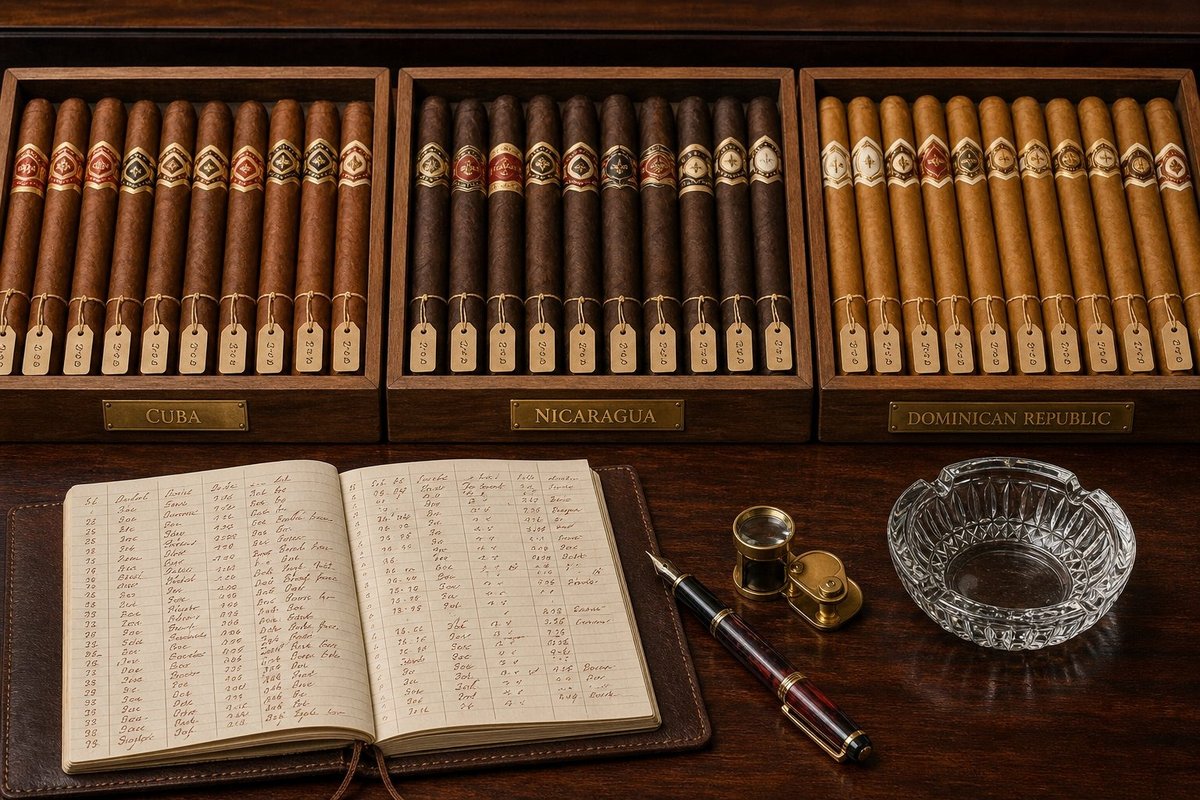
The Kaufmann Pairing Index (KPI) is the magazine's structured method for scoring cigar-and-spirit pairings. Unlike the Kaufmann Cigar Score, which evaluates a cigar on its own merits, the KPI evaluates the interaction between two products — the third flavor that emerges from their combination, sustained or fleeting, productive or competing. The KPI is exclusive to Cigar & Cocktail Magazine; it does not appear in the encyclopedia.
The Three Dimensions
Every KPI pairing is scored on three dimensions, each from 1 to 10, for a total possible score of 30.
Body Match (10 points). Do the two products have comparable weight and intensity? A full-bodied Nicaraguan with a delicate Sauvignon Blanc scores low on this dimension regardless of any other interaction; the wine simply disappears. A full-bodied Nicaraguan with an over-extracted Napa Cabernet also scores low; the wine overwhelms. Body match scores 8+ when the two products are evenly weighted such that neither dominates the palate.
Sweetness Contrast (10 points). Does the pairing create productive contrast between sweet and savory? A dry rye whiskey with a Maduro cigar scores high — the wrapper's natural sweetness finds productive contrast with the spirit's spice. A sweet Solera-style rum with a sweet Maduro cigar typically scores lower — the redundancy in the sweet dimension produces fatigue rather than complexity. The dimension is not about whether one or both products are sweet, but whether the contrast or harmony between them produces palate interest.
Finish Harmony (10 points). Does the pairing produce a sustained third flavor in the finish? The most important dimension and the most difficult to score reliably. A pairing might match on body and contrast on sweetness but produce nothing in the finish — the two products simply complete their individual flavor arcs without producing a combined third arc. The best pairings produce a finish character that is not present in either product alone and that persists for thirty seconds or more after the draw.
The Q1 Highest-Scoring Pairings
The two highest-scoring pairings in our Q1 2026 blind panel both reached 28/30:
Padrón 1964 Anniversary Maduro with Foursquare 2007 (KPI: 28/30). Body match scored 10 — both products are full-weight, neither overwhelms. Sweetness contrast scored 9 — the rum's slightly dry Caribbean tradition (Foursquare's house style is drier than most premium rums) creates productive contrast with the Maduro wrapper's natural sweetness. Finish harmony scored 9 — the pairing produces a sustained dark-cocoa, dried-fig, and salted-caramel third flavor that persists for a full minute after each draw and increases in intensity through the second third of the cigar.
Cohiba Siglo VI with Rémy Martin XO (KPI: 28/30). Body match scored 9 — the cigar is slightly more concentrated than the cognac but the difference is productive. Sweetness contrast scored 10 — the cognac's restraint (Rémy XO is the driest of the major XO houses) creates excellent contrast with the cigar's honeyed Vuelta Abajo signature. Finish harmony scored 9 — the rancio character of the cognac and the aged-cedar character of the cigar combine to produce a sustained dried-fig and toasted-walnut third flavor.
Mid-Range Pairings
Most cigar-and-spirit pairings score in the 18–24 range — productive combinations that work but do not transcend. A few representative examples from the Q1 panel:
- Davidoff Aniversario No. 3 + Glenmorangie 18 (KPI: 24/30) — refined and elegant, but the pairing produces a third flavor that fades quickly.
- My Father Le Bijou + Eagle Rare 17 (KPI: 23/30) — strong body match and sweetness contrast, but the finish does not sustain at the level the top pairings achieve.
- Arturo Fuente Hemingway Short Story + Diplomatico Reserva Exclusiva (KPI: 21/30) — pleasant, easy, lacks intensity.
- Cohiba Robusto + Old Fashioned (bourbon) (KPI: 19/30) — the bourbon's caramel competes with the cigar's honey rather than complementing it.
What the KPI Is Not
The KPI is not a substitute for taste. A pairing that scores 28/30 on our panel may not appeal to a smoker whose palate runs differently; a pairing that scores 21/30 may be a particular smoker's favorite combination. The KPI is a structured framework for documenting why a pairing works or does not — not a verdict on whether the smoker should prefer it.
The KPI is also not a brand-comparison tool. Two pairings using the same cigar with different spirits can both score 25+, and the choice between them is a matter of preference rather than quality. The point of the KPI is to clarify the dimensions on which pairings succeed, so the smoker can make informed choices about which dimensions matter most for any given evening.
Using the KPI at Home
The KPI works just as well at home as in our blind panel. The procedure: select two products you plan to pair. Smoke / sip each independently for the first ten minutes to establish flavor baselines. Then combine — sip the spirit, take a cigar draw, retrohale, sip the spirit again. Score the three dimensions out of 10. Total the score.
Pairings above 25 are worth repeating and recommending. Pairings between 18 and 24 are productive but not memorable. Pairings below 18 should be reconsidered — usually the body match or the sweetness contrast is failing, and a single substitution (different spirit, different cigar) will rescue the pairing without changing the overall plan.
This is the methodology. The bands, as always, come off before scoring.
The full KCS methodology is at cigarcocktailmag.com/kcs/methodology.html. From Cigar & Cocktail Magazine Q1 2026.