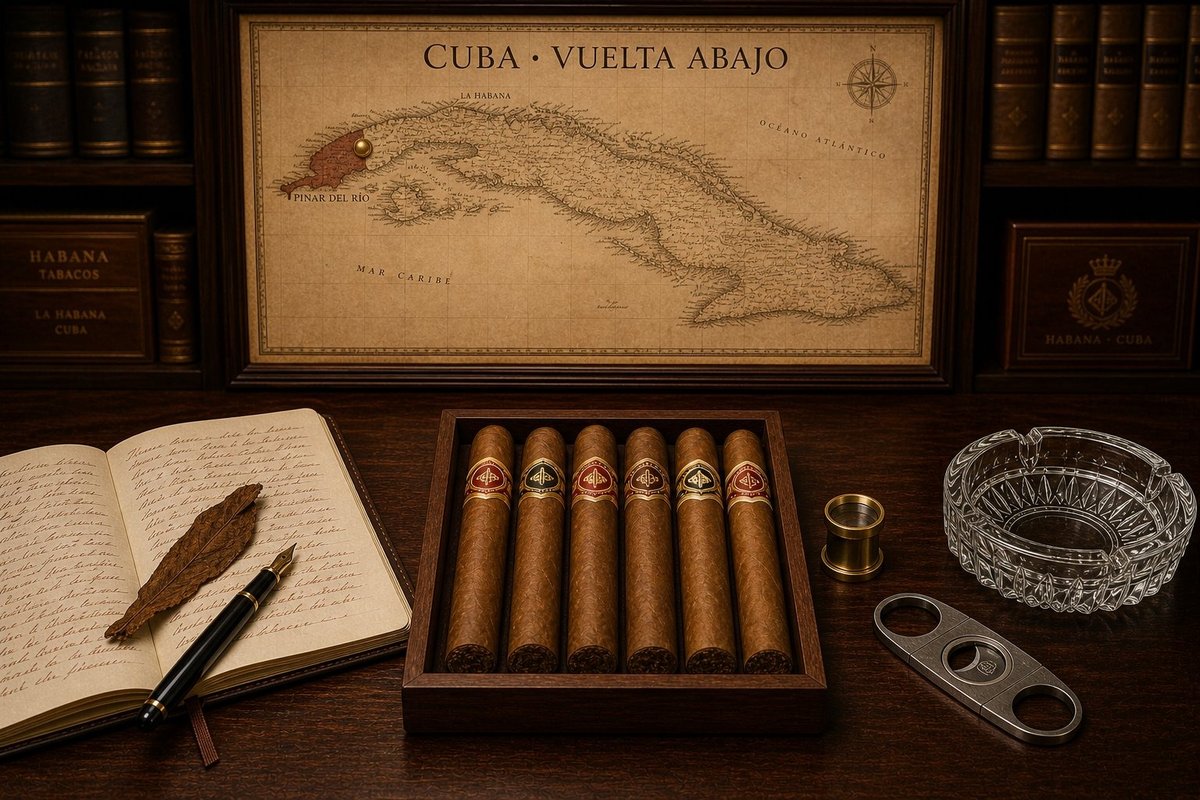
Five centuries of Cuban tobacco production, condensed into the moments that shaped what the cigar means today. From Columbus's first encounter with indigenous tobacco-smoking to the contemporary state monopoly, the Cuban cigar industry has survived colonial extraction, revolution, embargo, and three quality crises — and remains, by general consensus, the spiritual homeland of the premium category.
1492 — First Contact
On 28 October 1492, Columbus's expedition lands on the northeastern coast of Cuba. Crew members observe indigenous Tainos rolling dried tobacco leaves into cigars and smoking them in ritual contexts. The European adoption of tobacco begins almost immediately; within a generation, smoking habits have spread through the Spanish court and from there to the rest of Europe.
1717 — The Spanish Monopoly
Philip V of Spain establishes the Estanco del Tabaco, the Royal Tobacco Monopoly, granting the Spanish Crown exclusive rights to purchase Cuban tobacco at fixed prices for re-export to Europe. The monopoly impoverishes Cuban growers, triggers three uprisings (1717, 1721, 1723) known collectively as the Vega Revolts, and shapes the Cuban tobacco economy for a century. The monopoly is finally abolished in 1817.
1810s–1840s — The Brand Era Begins
With the end of the Spanish monopoly, Cuban tobacco growers and merchants begin establishing branded cigar companies for direct international sale. Por Larrañaga is founded in 1834, Punch in 1840, H. Upmann in 1844, Partagás in 1845. These houses establish the institutional discipline — the catador system for leaf evaluation, the triple-cap construction, the multi-pass fermentation — that defines premium cigar production globally to this day.
1875–1898 — The Golden Age
The late nineteenth century is Cuba's golden age of cigar production. Hoyo de Monterrey is founded in 1865, Romeo y Julieta in 1875, Bolivar in 1901. Havana becomes the cigar capital of the world; the major factories employ thousands of torcedores under conditions that include the famous lector tradition — readers paid by the workers themselves to read newspapers and literature aloud during the long rolling shifts.
1898–1902 — Spanish-American War & Independence
Cuba transitions from Spanish colony to American protectorate to independent republic. The American occupation period (1898–1902) integrates Cuban cigars deeply into the U.S. market; for the next sixty years, Cuban cigars are the dominant premium category in American smoking culture.
1959 — Revolution
The Cuban Revolution, led by Fidel Castro, overthrows the Batista government on 1 January 1959. Within two years, the cigar industry is fully nationalized; private brand ownership is abolished; the major marcas are consolidated under the new state enterprise that becomes Cubatabaco and later Habanos S.A.
1961–1966 — The Exile Diaspora
The families that owned the great marcas leave Cuba. Many establish themselves in the Dominican Republic, Honduras, Nicaragua, or Miami. The exile cigar industry that emerges from this diaspora — Padrón in Nicaragua, Fuente in the Dominican Republic, the Cuban-American houses in Miami — will eventually become the modern New World premium industry that challenges Habanos in the twenty-first century.
1962 — The U.S. Embargo
On 7 February 1962, President Kennedy signs the executive order establishing the U.S. trade embargo against Cuba. Cuban cigars are barred from legal import into the United States. The embargo remains in effect at every subsequent administration; as of 2026, it has been in continuous effect for 64 years.
1966 — Cohiba is Born
The Cohiba marca is created as a private label for Fidel Castro and senior Cuban government officials. Production is limited to the dedicated El Laguito factory in western Havana. Cohiba does not enter public commercial release until 1982; the brand becomes, within a decade, the most prestigious Cuban marca in international commerce.
1990s — The Boom
The "cigar boom" of the 1990s — driven by demographic factors, the launch of Cigar Aficionado magazine in 1992, and a generational rediscovery of premium smoking culture — produces unprecedented global demand for Cuban product. Habanos S.A. is established in 1994 as a joint venture between Cubatabaco and the Spanish company Altadis, modernizing distribution and pricing. The Behike line launches as Cohiba's prestige tier in 2010.
2010s — The Nicaraguan Ascendancy
The decade from 2010 to 2020 establishes Nicaragua as a peer producer to Cuba. Padrón, My Father, Aganorsa, Plasencia, and the Drew Estate operations consistently win blind tasting competitions. The Cigar Aficionado "Cigar of the Year" award is won by Nicaraguan production in seven of eleven years from 2010 to 2020. The Cuban industry begins to feel the competitive pressure for the first time in its history.
2018–2024 — The Pricing Crisis
Habanos S.A. announces a sequence of dramatic price increases between 2018 and 2024, repositioning Cuban product at the very top of global premium pricing. The strategy reflects both genuine production cost pressures (Cuban inflation, leaf shortages, factory disruption) and a deliberate luxury repositioning. The pricing crisis coincides with a quality crisis: blind panels in the early 2020s document construction defect rates at Cuban factories well above New World benchmarks. The combination produces the contemporary debate about whether Cuban cigars remain worth their premium pricing.
2026 — The Present
The Cuban industry in 2026 is recovering from the 2018–2024 disruption. Recent production batches show improving consistency. The flagship lines — Cohiba Behike, the prestige Edición Limitada releases, the upper Romeo y Julieta and Partagás tiers — continue to set the global benchmark when encountered in good condition. The mid-tier and routine production remains variable. The mythology persists. The leaf, when handled correctly, remains the finest on earth.
The next chapter of the timeline is being written now, by every aficionado who decides whether the Cuban premium is worth its current price. The Kaufmann Cigar Score's working position — that the best Cuban production is irreplaceable and the median Cuban production has been overtaken — is the editorial framework this magazine brings to that decision.
Cuba is profiled in depth in the World Cigar Atlas. From Cigar & Cocktail Magazine Q1 2026.