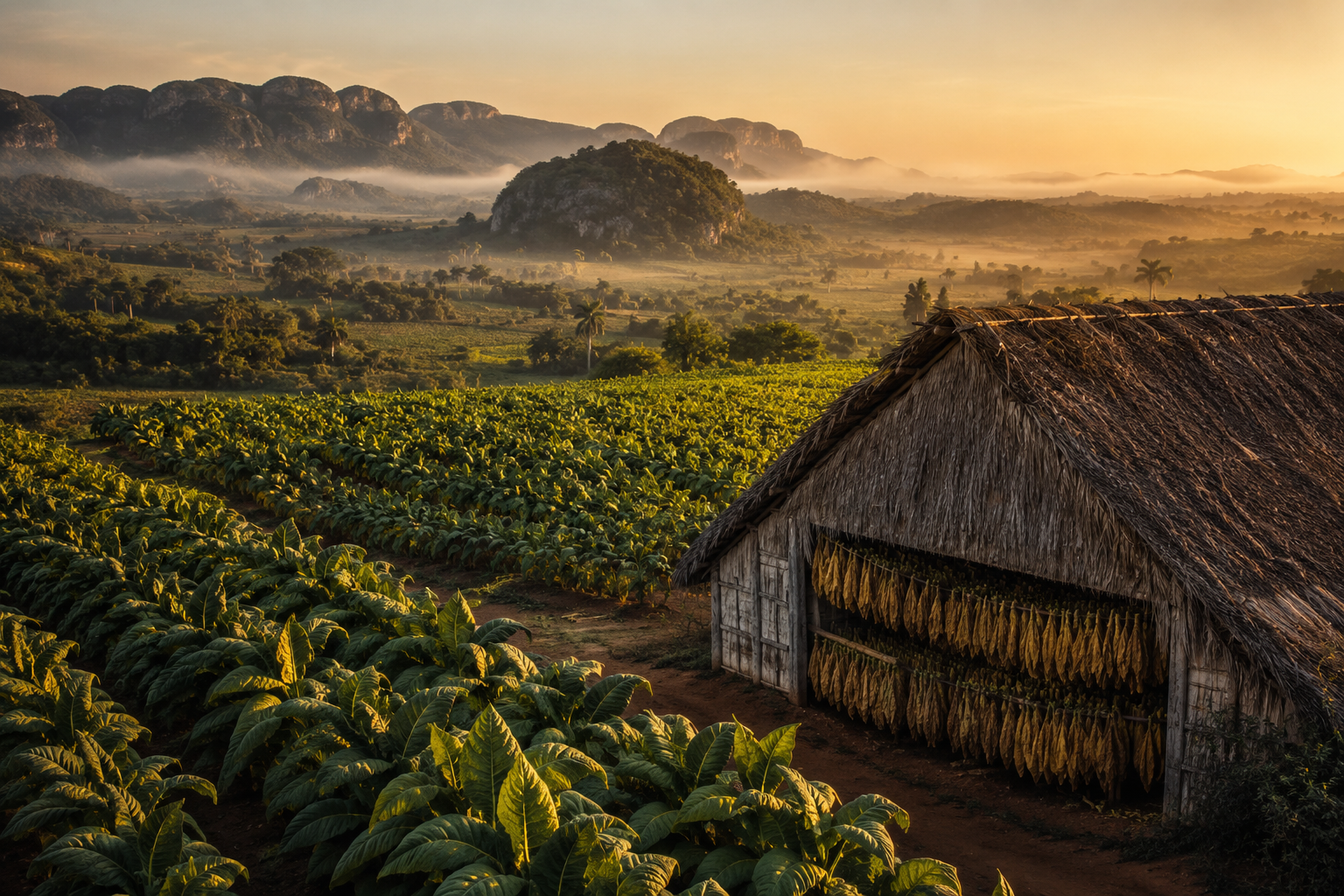
The Cuban cigar is the most over-discussed and under-evaluated object in luxury. Everyone has an opinion. Almost no one tastes blind. The result, after sixty years of embargo theater and travel-magazine fantasy, is a market where a $32 Cohiba Behike 56 sells out in Geneva in ninety minutes — while a $23 Padrón 1964 Anniversary Maduro, made by Cuban exiles in Estelí, scores higher every single time it lands on the blind panel.
What Cuba Still Owns
There is a flavor profile no other country has cracked. Call it the Vuelta Abajo signature — a cedar-and-honey midpalate, a faint tang of the sea on the finish, and an aromatic top note that registers somewhere between dried hay and cold coffee. The Partagás Serie D No. 4 has it. The Trinidad Fundadores has it in a more restrained, almost monastic way. The Cohiba Siglo VI carries it through twenty-eight different flavor checkpoints from light-up to nub, which is why it scored 95 on our blind panel and why even our most skeptical taster — who came in determined to find a Nicaraguan equivalent — admitted at minute forty: "Nothing else does this."
This is not nostalgia. This is soil chemistry. The Vuelta Abajo basin sits on a specific weathered limestone substrate that releases magnesium and calcium into the topsoil at concentrations no Central American valley replicates. Combined with the Pinar del Río microclimate — high humidity, low diurnal variation, salt-bearing trade winds — it produces a leaf that ferments differently. The Cubans have not "lost the recipe." They have the only kitchen on earth that produces this specific cake.
"Cuba has not lost the recipe. They have the only kitchen on earth that produces this specific cake."
What Cuba Has Lost
Construction. Consistency. Speed-to-market. Quality control as a daily discipline rather than a periodic recovery effort.
Of forty-one Cuban cigars we put through the blind panel for this issue, eleven had construction defects sufficient to affect the burn or draw. That is twenty-seven percent. The comparable Nicaraguan figure, drawn from the same vendors on the same week, was four percent. A 2018 Hoyo de Monterrey Epicure No. 2 box, sourced through La Casa del Habano Geneva and aged in our cellar at 65% RH for fifty-four months, produced three cigars in a row that tunneled in the first inch. The retail price on that box was $640. The same money buys you a five-vitola sampler from Padrón's 1964 Anniversary line and you will not pull a tunnel in fifty sticks.
This is the part Cuba apologists hate to hear. The leaf is still the best on earth. The factory floor has not kept up.
The Aging Question
Here is where the romantics get their revenge. Cuban tobacco rewards patience in a way Central American tobacco simply does not. A 2014 Bolivar Royal Corona, properly stored, is not just a better cigar than the 2024 release — it is a fundamentally different smoke. The ammonia has dissipated. The cedar has bloomed into something rounder and sweeter. The finish has acquired what cellarmasters in Cognac call rancio — a deep, leathery, almost dried-fig note that you cannot fast-track.
Nicaraguan tobacco ages differently. A 2014 Padrón 1964 tastes very similar to a 2024 Padrón 1964, because Padrón's three-to-five-year barn-aging protocol does most of the work before the cigar reaches you. Cuba, by contrast, ships you a half-finished smoke and asks you to complete it. If you have the discipline and the humidor space, this is an extraordinary privilege. If you do not — if you smoke them within twelve months of release, as most Americans now do via Geneva and Hong Kong intermediaries — you are paying premium prices for an unfinished product.
Practical Guidance
For American readers: yes, you can legally travel to Cuba under the "Support for the Cuban People" category. No, this does not require a guided tour. You book through third-country airlines (Copa via Panama, Aeromexico via Mexico City), bring cash in euros (US cards do not work), and file a simple affidavit on return. Budget approximately $150–200 per day for decent accommodation, meals, and transportation. The cigars are cheaper there — a box of Montecristo No. 2 runs about $180 at the LCDH versus $400+ on the secondary market in the US — but you are legally limited to bringing back $800 worth of Cuban goods total, including cigars. Bring an empty carry-on.
Our working position in 2026: buy the best Cuban production, age it properly, and smoke it with appropriate attention. The Cohiba Siglo VI, the Trinidad Fundadores, the Bolivar Royal Corona, the Partagás Serie D No. 4 — these remain, when encountered in good condition, among the finest premium cigar smoking experiences on earth. They are not, in 2026, reliably better than Padrón 1964, My Father Le Bijou, or Davidoff Aniversario. They are categorically different — and for the aficionado with humidor space, that difference is worth the premium.
The embargo theater, the mythology, the $30 bands — those things we will continue to taste around. The leaf itself, when it is at its best, is irreplaceable. We say this with the bands off.
Cuba is profiled in depth in the World Cigar Atlas. From Cigar & Cocktail Magazine Q1 2026.