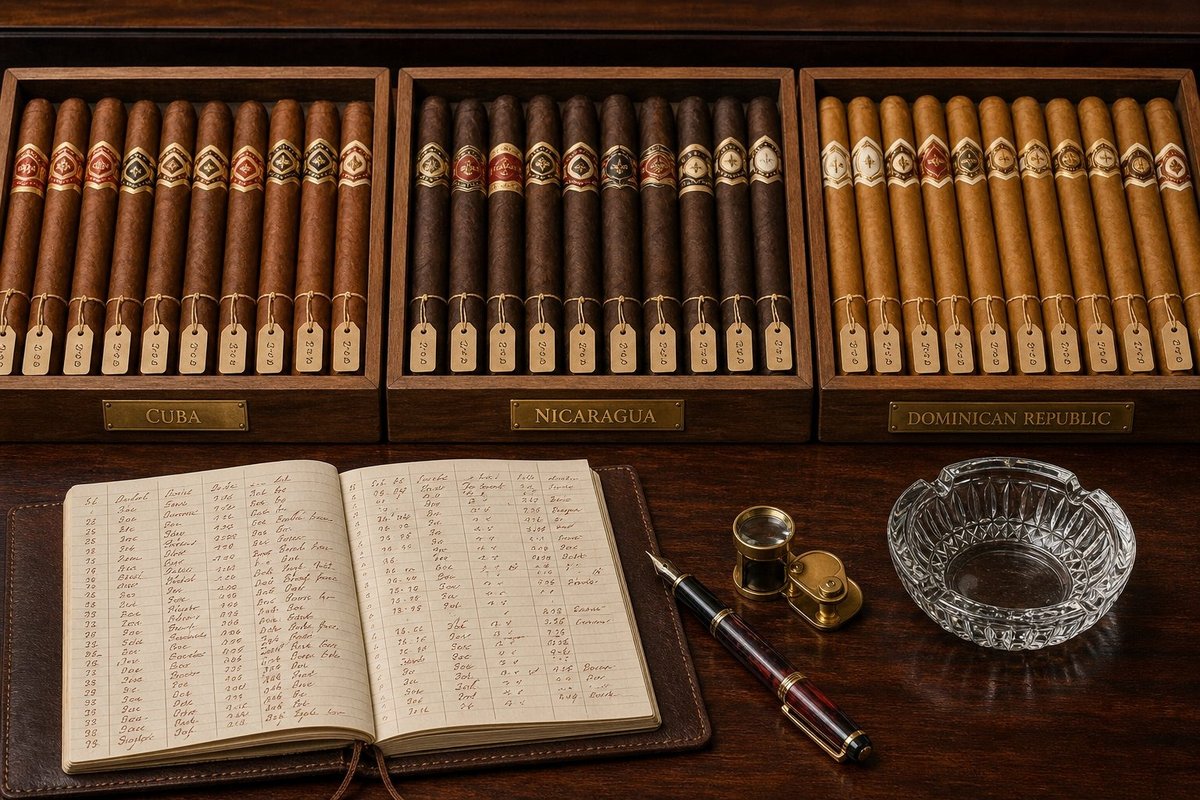
The moment you read a band, the tasting is over. The mind has already constructed the cigar it expects — the weight of reputation, the memory of the price tag, the ambient pressure of seventy years of Cuban mythology. You are no longer tasting the cigar. You are confirming the story you told yourself about it before you struck the match.
Why We Taste Blind
Over the years, I began realizing something unsettling — how deeply prestige influences taste itself. The moment people see a famous cigar band, the mind automatically expects greatness. Not because people are dishonest, but because this is simply how human beings work. Luxury has always been emotional. It works through expectation, memory, and narrative.
That realization eventually led me toward blind tasting. Not as provocation. Not as an attack on premium brands. But as a return to honesty.
Taste first. Prestige second.
Every score published in this magazine is the product of a blind tasting. The bands are removed before the cigars enter the scoring room. The tasters do not know what they are smoking. The identities are revealed only after scores have been assigned, written up, and committed to paper. This is not a clever marketing proposition. It is the only intellectually honest way to score a premium cigar in a world where a Cohiba band adds twenty-five dollars of perceived value before the first draw.
What the Blind Panel Found
In forty-one Cuban cigars put through our blind panel for the Q1 2026 issue, eleven had construction defects sufficient to affect the burn or draw. That is twenty-seven percent. The comparable Nicaraguan figure, drawn from the same vendors on the same week, was four percent.
A 2018 Hoyo de Monterrey Epicure No. 2 box, sourced through La Casa del Habano Geneva and aged in our cellar at 65% RH for fifty-four months, produced three cigars in a row that tunneled in the first inch. The retail price on that box was $640. The same money buys you a five-vitola sampler from Padrón's 1964 Anniversary line and you will not pull a tunnel in fifty sticks.
These results will offend the people they need to offend. This is not the article that tells you Cuba is back, or that Cuba never left, or that the 2024 harvest was "a return to form." Those pieces write themselves and they always end the same way — with the writer expensing a box of Montecristo No. 2s and quietly recommending you pre-order the next Cohiba Edición Limitada.
Three Promises This Magazine Makes
The Kaufmann Standard — the three promises every issue of this magazine makes to its readers — was not written as a marketing document. It was written because I kept reading cigar coverage that violated all three, and I found the violation more irritating each time I encountered it.
Promise one: We score blind. Always. Without exception. The methodology is documented in the KCS methodology section; the calibration sample is named; the dates and provenances of the cigars evaluated are recorded. If you disagree with a score, you have the information needed to reconstruct our reasoning. Disagreements based on different palates are honest. Disagreements based on different evidence are productive.
Promise two: We pay for the cigars. This magazine does not accept sample cigars for review. The cigars scored in the Ratings & Reviews section were purchased at full retail or at secondary-market prices, from authorized retailers or secondary vendors, with no manufacturer relationship involved in the selection. Where a factory visit or brand relationship exists, the disclosure appears in the review text. The corollary to this promise is that we review fewer cigars per issue than publications with more generous tobacco budgets. We consider this a feature, not a limitation.
Promise three: We publish the methodology. The Kaufmann Cigar Score (KCS v2.1) is a six-dimension 100-point scoring system documented in full in the encyclopaedia from which this magazine derives. Every dimension is defined. Every calibration cigar is named. The score for any cigar can be contested on the merits of the methodology. This is deliberate. A score without a methodology is an opinion wearing a number's clothes.
The Problem with Prestige
There is a specific cognitive error that afflicts cigar scoring: the authority bias in reverse. A taster who respects the canon — who knows the historical achievement of the Cohiba house, the extraordinary cigars the Vuelta Abajo has produced at its best — is structurally inclined to give the benefit of the doubt to a Cuban cigar that scores a tunneling draw as "acceptable construction variance." The same taster, presented with an identical defect in a Nicaraguan cigar from a house without a sixty-year legacy, marks it down immediately.
The band is the authority signal. Remove the band and the bias disappears. The cigar becomes the thing it actually is: a rolled tobacco product, evaluated on construction, draw, flavor, balance, evolution, and value. The legend becomes irrelevant. The price becomes a variable in the value dimension rather than a permission slip for lower standards.
This is not an anti-Cuban position. The best Cuban cigars — the Cohiba Siglo VI from a well-rested box, the Trinidad Fundadores on a slow afternoon, the Bolivar Royal Corona from a properly aged pre-2010 box — remain, in my judgment and in the data from our blind panels, among the finest premium cigar smoking experiences in the world. The blind test does not diminish Cuba. It protects Cuba from the reputational free-riding that allows substandard production to shelter under the same umbrella as the island's genuine achievements.
A great Cuban cigar does not need the band to be great. A mediocre one should not be shielded by it.
Why This Is The Right Time
The premium cigar world has changed more in the past thirty years than in the previous three hundred. The Nicaraguan ascendancy has produced cigars that compete with Cuban flagships on quality, sometimes exceed them, and often deliver a more reliable smoke. The Dominican Republic has consolidated. Honduras has stabilized. Mexico, Brazil, Ecuador, Cameroon, Indonesia, and the Philippines all contribute to the global premium market. The reference works that shaped my own education in this subject were written in different decades and assumed a world in which Cuba was unambiguously the standard.
That world is gone. In its place is a more interesting, more competitive, more honest premium market — one in which the best argument for a Cuban cigar is not the legend but the leaf. We find that argument compelling, when the leaf makes it.
When it does not, we say so. With the band off. That is the only way to be useful to a reader who is trying to decide what to put in their humidor.
The full KCS methodology is documented at cigarcocktailmag.com/kcs/methodology.html. From the Cigar & Cocktail Magazine Q1 2026 special editorial.