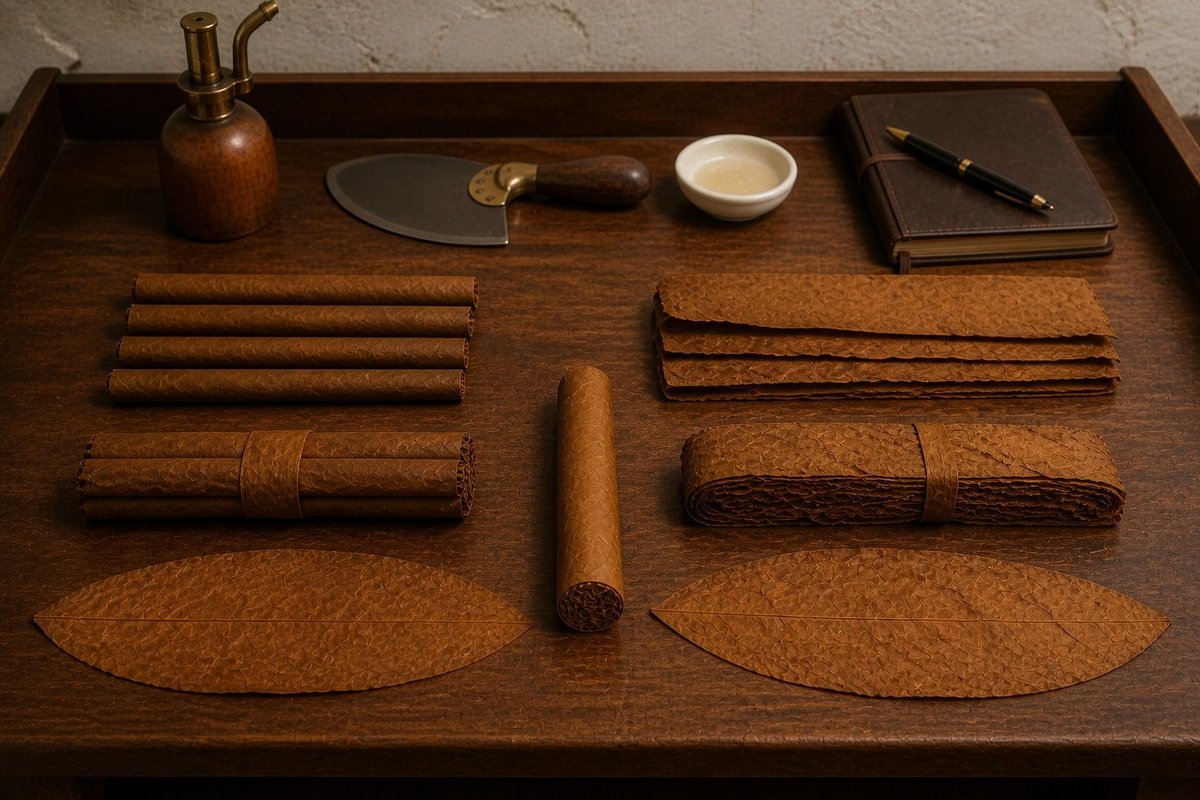
A premium handmade cigar is not one leaf. It is three or five or seven, each from a different plant, a different priming, sometimes a different country — layered with intention and a specific outcome in mind. The blender's job is to make the sum of those components taste inevitable: as though no other arrangement could have produced exactly this cigar.
The Three Components
Every premium handmade cigar has three distinct tobacco components, each with a different role:
The filler is the core — typically two to five leaves from different primings (volado, seco, viso, ligero) rolled together by the buncher. The filler provides the bulk of the cigar's mass, controls the draw resistance, and supplies most of its strength and a substantial portion of its base flavor. A filler dominated by ligero produces a full-strength, slow-burning cigar with concentrated flavor in the final third. A filler dominated by volado produces a mild, fast-burning cigar with good combustion but less body. Most serious blends balance three or four primings in deliberate proportion.
The binder is the leaf that the buncher rolls around the filler to consolidate it before passing the bunch to the roller. The binder contributes to both combustion and flavor; it is often from a more elastic, durable leaf than the wrapper — Nicaraguan or Mexican San Andrés binders are common in complex blends — and its principal role is structural. A good binder burns evenly, resists cracking under humidity variation, and adds a secondary flavor layer that is detectable in the midpalate without dominating the wrapper's contribution.
The wrapper is the outermost leaf — one leaf, spiral-applied from foot to head by the roller. The wrapper is the most expensive component: it must be seamless, elastic, aesthetically uniform, and flavor-contributing. The premium wrapper leaf used in flagship production is grown and harvested with more care than any other tobacco leaf in the world. Connecticut Shade wrapper — grown under cheesecloth canopies in the Connecticut Valley to reduce UV exposure and produce a lighter, thinner leaf — costs twenty to forty times more per pound than the filler tobacco it covers. The wrapper contributes approximately thirty percent of the cigar's perceived flavor, disproportionate to its mass.
How a Blend Is Constructed
A new blend begins with the blender identifying a target flavor profile: the intended strength, the dominant flavor notes, the evolution across three thirds, and the finish character. This target is typically expressed as a reference — "similar to the Padrón 1964 Maduro but lighter in the first third and more cedar-forward in the second" — or as a completely new brief.
The blender then selects candidate tobaccos from inventory and constructs trial blends, typically five to ten variations, that approach the target from different angles. Each trial is smoked by the blending team, scored on the target dimensions, and refined. The process takes weeks for an established variation on an existing line; it can take two to three years for an entirely new blend built from newly aged tobacco.
The variables are numerous and interact non-linearly. A small change in binder leaf — replacing a Nicaraguan Jalapa binder with a San Andrés Mexican — can alter the perceived strength by a full step and shift the dominant flavor notes from leather-and-earth toward chocolate-and-spice. Adding a high-priming ligero filler component increases both strength and body but slows the burn rate; reducing it risks a thin midpalate. The wrapper choice is often made last, after the filler-binder combination has been finalized, because the wrapper's contribution to flavor is best evaluated against an established baseline.
Why Machines Cannot Do This
Mechanical cigar production exists and produces consistent product. What it does not produce is what a master blender produces: the judgment about which specific combination of tobaccos, from which specific vintage and origin, will produce the intended character in a cigar that will be smoked three to five years after blending.
The blender is tasting backward in time. The tobacco being selected has already been aged; the cigar being constructed will be aged further. The question the blender is answering is not "what does this combination taste like today?" but "what will this combination taste like in 2028, after three years in a cedar-lined humidor at 68% RH, when the ammonia has dissipated and the volado has integrated with the ligero and the Connecticut wrapper has developed its characteristic dried-fruit finish?"
That answer requires a specific kind of palate memory — a memory not of flavors but of transformations. The great blenders — Pepín García at My Father, Benji Menéndez in his Padrón years, Henke Kelner at Davidoff's Tabadom — are distinguished not by their ability to describe what a tobacco tastes like today but by their ability to predict what it will become. This is irreducibly human expertise. No algorithmic model of flavor development has yet approached it.
The Complexity Debate
There is a persistent debate in premium cigar culture about complexity — whether a five-country blend that changes character across seven flavor checkpoints is inherently superior to a single-origin puro that delivers one perfectly sustained note for ninety minutes. The KCS methodology takes no position on this question; both approaches can score in the Outstanding tier. What the methodology does require is that a complex blend actually delivers on its complexity — that the transitions are genuine rather than the random variation of inconsistent construction — and that a single-origin puro delivers its note at a quality level that justifies the simplicity.
The most honest answer to the complexity debate is that the right blend is the one that was intentional. A five-country blend that tastes like a committee is not complex; it is confused. A single-origin puro that delivers nothing but combustion for an hour is not simple; it is empty. The architecture of the blend is only as valuable as the vision that designed it.
From Cigar & Cocktail Magazine Q1 2026. The blending process is covered in detail in the From Seed to Smoke section of the reference library.