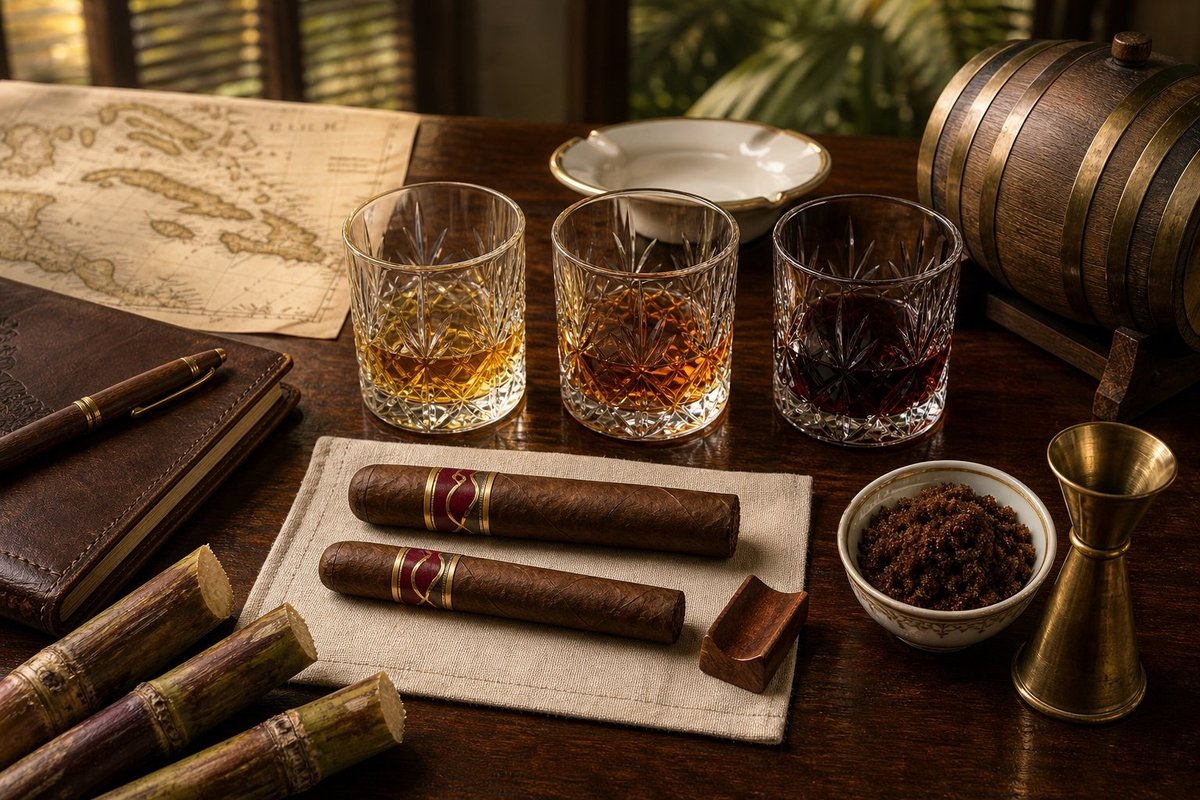
Rum was the cigar's first companion. The two crops grew on the same Caribbean soil, were processed by the same labor force, were exported through the same ports, and arrived in European drawing rooms together. The pairing is not invented; it is geographic. What we taste when we pair a Bolivar Royal Corona with a fifteen-year Caribbean rum is two products of one terroir, finished in two different chambers.
From Sugarcane to Distillate
The premium rum production chain begins with the sugarcane crop. Two distinct base materials produce distinct rum traditions: molasses-based rum (the dominant tradition, using the dark syrup left after sugar crystallization) and cane-juice-based rum (the rhum agricole tradition, principally French Caribbean, using freshly pressed sugarcane juice without crystallization). Molasses produces a heavier, sweeter, more caramel-driven spirit. Cane juice produces a grassier, drier, more vegetal spirit with distinctive terroir expression.
Fermentation converts the sugars to alcohol. The yeast strain, fermentation temperature, and duration determine substantial portions of the final flavor profile. Industrial molasses-rum production uses fast fermentations (24–48 hours) with selected yeast strains. Traditional Jamaican production uses long, slow fermentations (sometimes 10+ days) with wild yeasts, producing the characteristic "Jamaican funk" — high-ester, fruit-forward, intensely aromatic spirits that pair particularly well with full-bodied Nicaraguan cigars.
Distillation follows. Column-still distillation (the modern industrial standard) produces a cleaner, more neutral spirit with less character from the base material. Pot-still distillation (the traditional method, still used by Appleton Estate, Mount Gay, Foursquare for premium expressions) produces a richer, more flavor-dense spirit that preserves more of the fermentation character. Most premium aged rums use a blend of pot-still and column-still distillate; the proportion is one of the principal house-style decisions.
The Aging Question
Aged rum acquires its character principally during barrel aging. The standard tradition uses ex-bourbon American oak barrels, which contribute vanilla, caramel, coconut, and toasted-wood notes. Aging in former sherry, port, cognac, or wine casks adds additional complexity — these "finishing" expressions have become a substantial category in premium rum.
Tropical aging accelerates the process. A rum aged ten years in Barbados, where average temperatures and humidity are substantially higher than in Scotland, will show evolution comparable to a Scotch whisky aged eighteen to twenty-two years. This is partly a function of the higher angel's share in tropical aging (often 6–8% annual loss versus 2% in Scotland) and partly the chemistry of barrel interaction at elevated temperatures. A "twelve-year Caribbean rum" and a "twelve-year Scotch" are not making the same statement; the rum has done substantially more aging work in the same chronological time.
The age statement question in rum is complicated. Some producers (Foursquare, Mount Gay) use minimum-age statements, where the youngest component of the blend is the stated age. Others (notably Solera-aged Spanish-tradition rums like Ron Zacapa, Diplomatico Reserva Exclusiva) use older-component-emphasis statements, where the "23" on the label does not mean 23-year minimum age — it means components of various ages including some 23-year material. Neither system is dishonest, but they communicate different things. The serious aficionado checks the back label and the producer's documentation.
Three Houses, Three Styles
The premium aged rum category in 2026 organizes around three principal styling traditions:
The Spanish Caribbean tradition (Cuba, Dominican Republic, Guatemala, Venezuela) emphasizes Solera-style blending, longer molasses fermentation, and a sweeter, rounder, more dessert-like profile. Representative: Ron Zacapa XO, Diplomatico Reserva Exclusiva, Havana Club Selección de Maestros, Brugal 1888. These rums pair particularly well with medium-bodied Dominican cigars where the dried-fruit and cocoa notes find common ground.
The British Caribbean tradition (Jamaica, Barbados, Guyana, Trinidad) emphasizes pot-still distillation, ester-driven funk, and a drier, more spirit-forward profile. Representative: Appleton Estate 21, Mount Gay XO, Foursquare ECS series, El Dorado 21. These rums pair particularly well with full-bodied Nicaraguan cigars where the dark fruit and leather notes from Estelí terroir echo the rum's tropical-fruit ester character.
The French Caribbean tradition (Martinique, Guadeloupe, Marie-Galante) uses rhum agricole production from fresh cane juice and emphasizes a drier, more vegetal, terroir-driven profile. Representative: Clément VSOP, Trois Rivières VSOP, Neisson Extra Vieux, Damoiseau Vieux. These rums pair particularly well with Connecticut-shade Dominican cigars (Davidoff, AVO, Macanudo) where the rum's restrained character complements rather than overwhelms.
The Cigar Pairing Logic
The pairing rule for aged rum and cigars follows the strength-match principle. A full-strength Nicaraguan demands a robust rum (Appleton 21, Foursquare ECS Mark XII, El Dorado 21+); a medium-bodied Dominican wants a balanced expression (Zacapa XO, Diplomatico Reserva Exclusiva, Brugal 1888); a delicate Connecticut-shade smoke is best paired with restrained French rum or a young Spanish-tradition rum.
The rule for serving: pour two ounces in a tulip glass. Add no ice. Let the rum breathe for a minute after pouring; the aromatic compounds need time to develop on the surface. Take the first sip before lighting the cigar — establish the rum's flavor baseline. Then light the cigar, take the first draw, retrohale, take a second sip of rum. The combination should produce a third flavor that is not present in either component alone. That third flavor — call it the pairing — is what we are looking for.
The best pairings produce a sustained third flavor across the entire smoke. The Barbancourt 15-Year with a Padrón 1964 Anniversary Maduro produces a sustained note of dark cocoa, dried fig, and salted caramel that does not appear in either component alone. The Foursquare 2007 with a Cohiba Siglo VI produces a sustained note of leather, espresso, and dried orange peel. These are the conversations the cigar and rum traditions have been having since they grew up on the same islands.
The complete cigar-and-rum pairing guide is in the Pairings section. From Cigar & Cocktail Magazine Q1 2026.