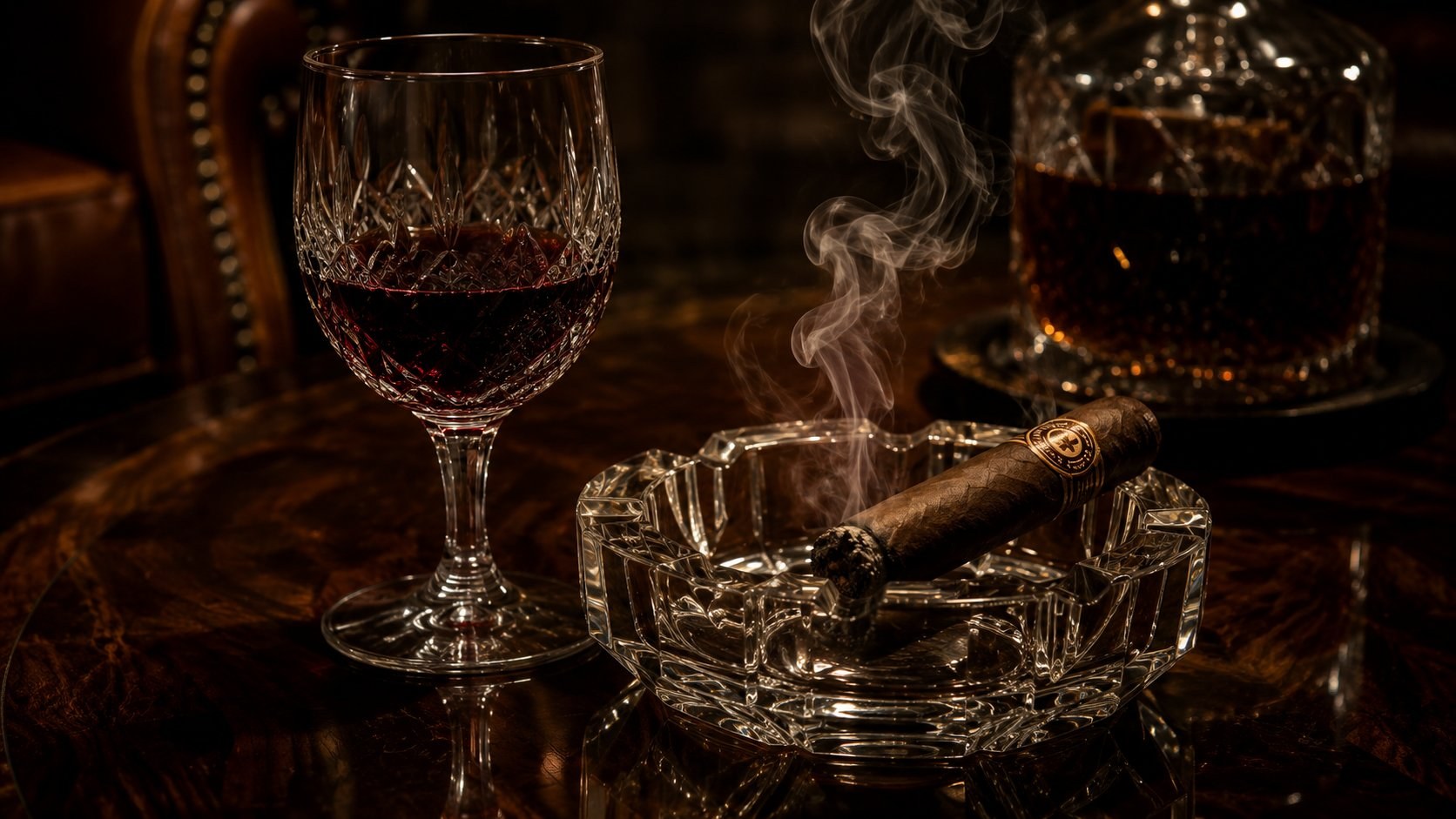
American cigar culture has a wine problem. Not a problem of quality, but of habit. The default pairing in most U.S. lounges is bourbon, rum, or cognac — all excellent choices, none of them complete. For most of European cigar history, the natural partner of a serious cigar was wine, and specifically the wines of the cold months: the structured reds of Tuscany and the Rhône, the fortifieds of Portugal and Spain, the dessert wines of the Mosel.
What follows is the working list — nine wines from six European countries that every serious cigar smoker should know before the next snowfall. Each entry includes the producer style most worth seeking, the cigar profile it serves best, and a brief note on why the pairing actually works on the palate.
The Full-Bodied Reds
01 · Châteauneuf-du-Pape (Southern Rhône, France)
The textbook winter red. A blend dominated by Grenache, with Syrah and Mourvèdre providing structure and dark-fruit weight, Châteauneuf-du-Pape produces wines of warmth, herb, and gentle power — the famous garrigue note of Provençal herbs woven through dark cherry and worn leather. Look for Domaine du Vieux Télégraphe, Château de Beaucastel, or Clos des Papes (~$60–$95 retail).
Cigar pairing: medium-bodied Cuban or Nicaraguan Habano wrappers. Partagás Serie D No. 4. Hoyo de Monterrey Epicure No. 2.
02 · Brunello di Montalcino (Tuscany, Italy)
Italy's most age-worthy traditional red, made exclusively from Sangiovese Grosso, aged a minimum of four years before release. The result is a wine of tannic precision, dried-cherry concentration, and a finish that runs thirty seconds or longer in the best bottlings. Look for Argiano, Banfi, or Il Poggione ($45–$80) for everyday excellence.
Cigar pairing: Dominican puros with Connecticut or Sumatra wrappers. Davidoff Aniversario. Fuente Hemingway Short Story.
03 · Barolo (Piedmont, Italy)
The Nebbiolo grape produces wines of unequaled aromatic complexity — rose petal, tar, dried fig, truffle, leather. Barolo demands age (the best vintages drink at fifteen to twenty-five years) and rewards patience. Producers worth seeking: Giacomo Conterno, Bruno Giacosa, Vietti, G.D. Vajra ($90–$300+).
Cigar pairing: aged Cuban Pirámides and Belicosos. Montecristo No. 2 with five years box-age. Bolívar Belicosos Finos. One of the great unstated alliances of cigar culture.
04 · Amarone della Valpolicella (Veneto, Italy)
Made from grapes dried on bamboo racks for three to four months before fermentation, Amarone produces wines of extraordinary concentration: 15–16% alcohol, raisin and dried-fig sweetness, an almost port-like depth. Look for Quintarelli ($200+), Allegrini, or Tommasi ($55–$110).
Cigar pairing: Nicaraguan Maduros with significant body. Padrón 1964 Anniversary Maduro Torpedo. Liga Privada No. 9 Toro.
"Amarone is the wine for the night the snow refuses to stop falling and the conversation has reached the third bottle. A Padrón 1964 beside it is one of the deepest pairings in any tradition."
The Iberian Powerhouses
05 · Rioja Gran Reserva (Rioja, Spain)
Tempranillo-based wines aged a minimum of five years before release. The traditional Rioja Gran Reserva style — Lopez de Heredia, La Rioja Alta — produces wines of haunting complexity: dried strawberry, sweet vanilla, dusty leather. The category is dramatically underpriced compared to its Italian and French peers ($45–$120 for excellent examples).
Cigar pairing: medium-bodied Hondurans and Dominican Habanos. Camacho Triple Maduro. Romeo y Julieta Reserva Real.
06 · Ribera del Duero (Castilla y León, Spain)
Spain's more muscular Tempranillo style, grown at higher altitude. Darker fruit, firmer tannin, greater alcohol than Rioja. Vega Sicilia is the legendary estate ($500+); Pesquera, Alion, and Emilio Moro produce serious wines at $35–$90.
Cigar pairing: full-bodied Nicaraguan and Honduran Maduros. My Father Le Bijou 1922. Joya de Nicaragua Antaño.
The Fortified Greats — Cigar Pairing's Crown Jewels
07 · Vintage Port (Douro, Portugal)
The canonical cigar pairing. Vintage Port is declared only in exceptional years — 2017, 2016, 2011, 2007, 2003 are recent benchmarks — producing fortified wines of dark fruit, chocolate, and sweet structural power. Taylor Fladgate, Graham's, Dow's, and Quinta do Noval are the historic houses ($75–$300 for vintage; $40–$60 for Late Bottled Vintage).
Cigar pairing: the most reliable cigar-wine pairing in existence. Any Maduro from any country. The chocolate-and-dried-fruit profile locks into the espresso-and-cocoa notes of a serious Maduro in a way that has been documented for two hundred years.
08 · Madeira — Bual or Malmsey (Madeira, Portugal)
The most undervalued wine on this list. Madeira survives oxidative aging — heat-aged in attic-warm vaults for decades — producing wines that taste of dried apricot, walnut, salted caramel, and aged tobacco. A 1968 Henriques & Henriques Bual can be found for $200 — a 1968 first-growth Bordeaux of equivalent rarity costs ten times as much. The connoisseur's secret.
Cigar pairing: Cuban Connecticut wrappers and aged Habanos. Cohiba Siglo VI. Romeo y Julieta Churchill.
09 · Pedro Ximénez Sherry (Jerez, Spain)
The darkest, sweetest, most concentrated wine on this list. Made from sun-dried grapes and aged in soleras for decades, Pedro Ximénez ("PX") produces a wine the color and viscosity of espresso. Toro Albalá, Equipo Navazos, Lustau, and Valdespino produce serious examples ($35–$150).
Cigar pairing: aged Maduros and the strongest cigars in the humidor. Padrón 1926 Series. Arturo Fuente OpusX. PX is the wine to serve when the second cigar is lit.
The Practical KPI Pairing Table
| Wine | Mild | Medium | Full |
|---|---|---|---|
| Châteauneuf-du-Pape | 78 | 89 | 85 |
| Brunello di Montalcino | 82 | 91 | 85 |
| Barolo | 76 | 88 | 92 |
| Amarone | 72 | 86 | 94 |
| Rioja Gran Reserva | 83 | 90 | 84 |
| Ribera del Duero | 74 | 87 | 91 |
| Vintage Port | 81 | 92 | 95 |
| Madeira Bual/Malmsey | 90 | 87 | 78 |
| Pedro Ximénez Sherry | 70 | 84 | 93 |
Three Bottles Every American Cigar Smoker Should Own This Winter
1. A Late Bottled Vintage Port. Taylor Fladgate or Graham's, ~$40. The everyday wine for everyday cigars.
2. An Amarone della Valpolicella. Tommasi or Allegrini, ~$60. For cold nights with the full-bodied Nicaraguan that has been waiting in the humidor.
3. A Rioja Gran Reserva. La Rioja Alta Gran Reserva 904, ~$70. For the middle-weight evenings — the ones that happen most often.
Total investment: $170. Coverage: roughly 80% of cigar pairings an American smoker will face this winter.
Why Winter Wines Now
Winter wines are seasonal in the way long evenings are seasonal — they reward time, conversation, and the slow lengthening of attention that the cold months produce naturally and the warm months obscure. A great Vintage Port at the end of a January evening is not a different drink than the same Port poured in July. It is the same wine; January is just the context in which its qualities become impossible to overlook.
The American cigar smoker who has spent the last ten years building a bourbon collection has built half a cellar. The other half — the European half — costs less than most people imagine, ages better than most spirits, and produces pairings the bourbon-only smoker has not yet experienced. The first time a Padrón 1964 meets an aged Amarone, the smoker understands what has been missing.
— R.K.