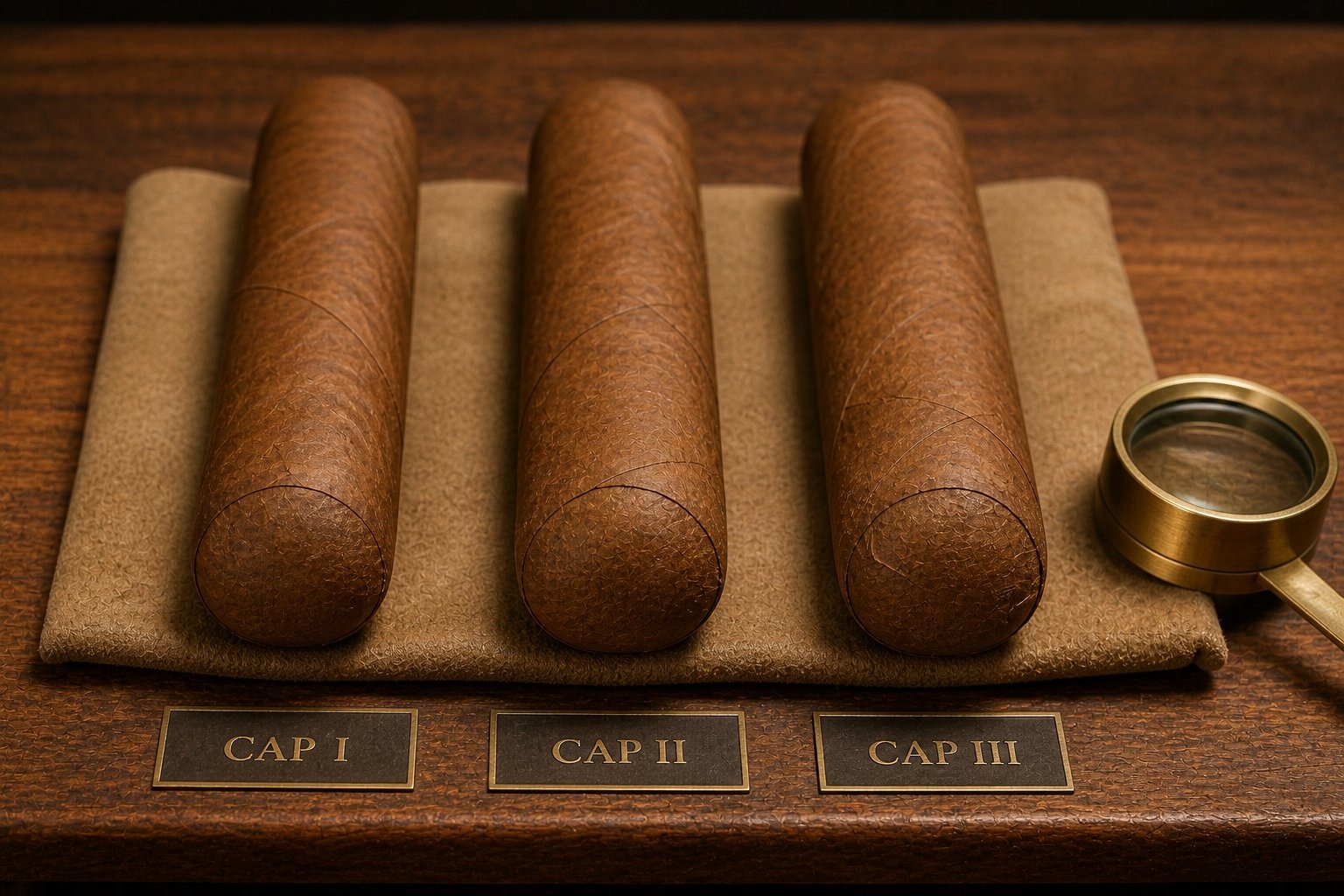
The cap is the small finishing piece of wrapper that closes the head of the cigar. Its function is structural — it prevents the wrapper from unraveling — and aesthetic, the finishing flourish of the rolling process. But its real value, for the smoker who wants to read a cigar before lighting it, is diagnostic. The cap announces the cigar's rolling tradition before the band is read.
Three cap styles exist in commercial production. The single cap is the simplest and is the standard of machine-made cigars: one disk of wrapper, one visible seam, one operation. The double cap is the modern American premium standard: two overlapping disks, two faintly visible seams, the workmanlike finish of most contemporary New World premium production. The triple cap is the Cuban canonical construction: three small wrapper pieces in succession, three faintly visible overlapping seams, and the visual signature that the discerning smoker should train his eye to recognize.
The triple cap takes time. An experienced Cuban torcedor produces one in twenty to thirty seconds, against perhaps ten to fifteen seconds for a double. The work is done by feel as much as by sight: each disk laid at exactly the right angle, pressed with precisely calibrated pressure, sealed with the smallest possible amount of tragacanth gum. The result is the smooth, layered head that a Cuban Habano carries from the rolling room to the humidor — a head that appears to flow into the barrel with no visible step.
Why does this matter to the smoker? Three reasons.
First, the triple cap is the principal visual sign by which a counterfeit Cuban cigar can be distinguished from a real one. Counterfeiters work under time pressure with inexperienced labor; they produce single caps or sloppily executed double caps and pass them off as Habanos. A "Cuban" cigar with a single cap is, with extremely high confidence, a counterfeit. A "Cuban" cigar with a poorly executed double cap is suspect. The triple-cap test is not the only counterfeit indicator — the band, the box, the cellophane, the cigar's smell, the cigar's burn all provide additional signal — but it is the easiest single test the smoker can perform without equipment, and it is the test that catches the most counterfeits.
Second, the triple cap is a reliable proxy for the discipline of the entire production chain. A factory that finishes its caps with three precisely placed disks is a factory that almost certainly fermented its tobacco properly, aged it long enough, sorted its wrappers carefully, and trained its torcedores for years. The cap is the last step of rolling. A producer who does this step right has, in all likelihood, done the previous steps right too.
Third — and this is the most personal of the three reasons — the triple cap is a small piece of culture that the smoker can read at sight. Two hundred years of Cuban factory tradition, the work of generations of torcedores, the institutional memory of the great marcas: all of it is visible on the head of the cigar in your hand, if you know what to look for. Most smokers do not. The smokers who do are reading something the cigar's own makers put there for them.
How to look. Hold the cigar at eye level under a strong directional light, head facing the eye, and examine the cap surface from a slight angle. Count the seams. A single shows one circular line; a double shows two; a triple shows three. The seams are easier to see on paler wrappers (Claro, Colorado Claro) and harder on darker ones (Maduro, Oscuro). A small loupe of three to ten times magnification helps when the seams are faint.
Then examine the cap-to-barrel transition. A single cap typically transitions abruptly. A double cap transitions more smoothly. A triple cap is the smoothest of all — the head appears to flow into the barrel with no visible step.
And finally, check the symmetry. A premium triple cap is essentially perfectly circular and centered on the cigar's axis. A double cap is almost as symmetrical. A single cap, particularly a machine-made one, often shows slight irregularities — an off-center seam, a slight oval shape, a visible adhesive halo. The presence of those irregularities does not, alone, identify the cap as a single. But their absence is a strong signal of premium construction.
That is the test. It takes ten seconds. It will, over a smoking lifetime, save the reader from a great many disappointments and confirm a great many quiet pleasures.
— Radim Kaufmann, May 2026