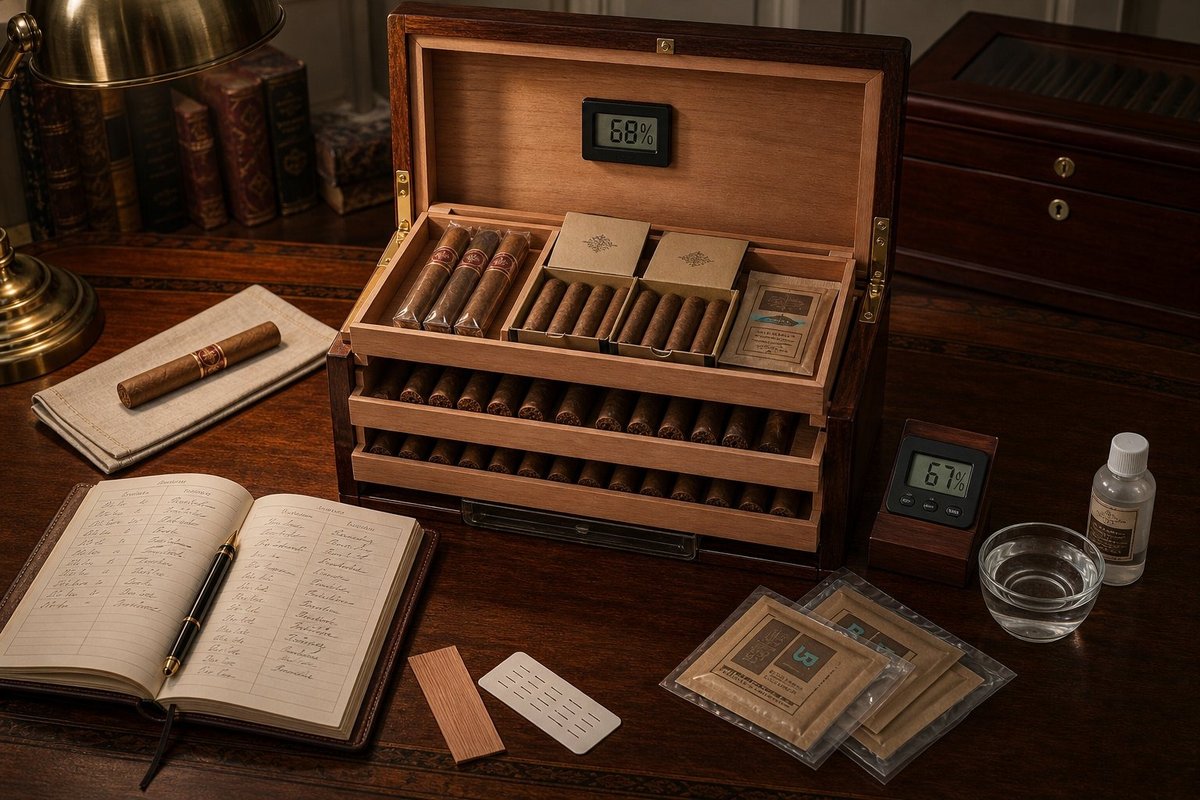
A humidor is not optional. Premium cigars are biological objects with a narrow tolerance for ambient conditions; outside that tolerance, they spoil quickly and irreversibly. The good news is that maintaining proper humidor conditions, once established, requires approximately five minutes of attention per week.
The Target Conditions
The premium cigar's preferred storage environment is 65–70% relative humidity at 18–21°C. Within this range, the cigar's wrapper maintains its elasticity, the binder retains its structural integrity, the filler develops its mature character through controlled aging, and the volatile aromatic compounds that define the cigar's mature flavor profile develop gradually rather than dissipating.
Outside this range: below 60% RH the cigar begins to dry out, losing essential oils and developing the brittle wrapper and harsh smoke character of "dead" tobacco; above 75% RH the cigar becomes susceptible to mold (the white-fuzzy variety, not the harmless plume of properly aged tobacco) and to plume-confusion where the smoker mistakes mold for the desirable surface bloom of properly aged tobacco.
Temperature: above 24°C the cigar becomes susceptible to tobacco beetle infestation (the small brown beetle Lasioderma serricorne, whose larvae tunnel through the filler and destroy the cigar from the inside); below 16°C the cigar's aging process effectively halts.
The Humidor Itself
A working humidor is Spanish cedar lined (the cedar absorbs and releases moisture, contributing to ambient humidity stability; the cedar's natural oils also slow the development of tobacco beetle infestation); sealed (the seal must be tight enough that a sheet of writing paper inserted between the lid and the body cannot be pulled free without tearing); and properly seasoned before first use.
The seasoning protocol: before placing cigars in a new humidor, the cedar interior must be brought to operating humidity. This is achieved by placing a small bowl of distilled water inside the closed humidor for 48–72 hours, with the humidor's humidification device active but no cigars present. The cedar absorbs the moisture; the interior reaches operating humidity; the cigars can then be transferred from their original packaging into the humidor.
A humidor that has not been seasoned will draw moisture out of the cigars placed into it, dropping their humidity below operating range within days. The cigars dry out, the wrapper cracks, and the collection is damaged before the new owner realizes what has gone wrong.
The Humidification Device
Three categories of humidification device are in current use. The passive humidification device (a small reservoir containing distilled water and a porous medium) is the traditional choice and works adequately for small humidors (fewer than 50 cigars). The Boveda packet (a two-way humidification packet, sold in 65%, 69%, and 72% RH calibrations) is the modern standard and works for humidors of any size. The electronic humidification device (a humidifier with active humidity control) is appropriate for very large humidors (cabinets, walk-ins) where passive devices cannot maintain stable conditions.
The Boveda packet system is, in 2026, the operational standard for the serious collector. The 65% RH packets are appropriate for the cigar collector who prefers a slightly drier storage environment (the working choice for those who smoke cigars within months of acquisition); the 69% RH packets are the most commonly used and align with the modern industry's recommended storage humidity; the 72% RH packets are appropriate for very dry climates or for the collector who specifically wants to maintain the higher humidity range.
The Hygrometer
A humidor without a working hygrometer is operating blind. The digital hygrometer (combined temperature and humidity display) is the operational standard; analog hygrometers are unreliable in the precision range required for serious cigar storage. A second hygrometer placed at a different location within the humidor provides redundancy and detects calibration drift.
The hygrometer must be calibrated. The standard calibration procedure (the "salt test") places the hygrometer in a sealed bag with a small bowl of damp table salt for 24 hours; at the end of the period, the hygrometer should read 75% RH. Any deviation from this reading is the calibration offset, which is then applied to subsequent measurements. Most digital hygrometers in the premium tier have factory calibration that is within 1–2% RH; the salt test confirms or corrects this.
The Common Mistakes
The five mistakes that destroy collections: (1) not seasoning the humidor before first use, with consequent moisture loss from the first batch of cigars; (2) using tap water instead of distilled water, with consequent mineral deposit and humidification device failure; (3) placing the humidor in direct sunlight, with consequent temperature variability that exceeds the operating range; (4) opening the humidor unnecessarily, with consequent humidity oscillation that stresses the cigars; (5) storing cigars in their cellophane sleeves permanently, which slows the cigar's aging interaction with the humidor environment.
The properly maintained humidor is a stable platform for the collection that will mature within it. The maintenance is minimal once the system is operational: weekly hygrometer check, monthly humidification device refresh, quarterly inspection for any signs of mold or beetle activity. The collector who establishes the discipline returns to their humidor years later to find a collection that has matured into something substantially better than it was when first acquired.