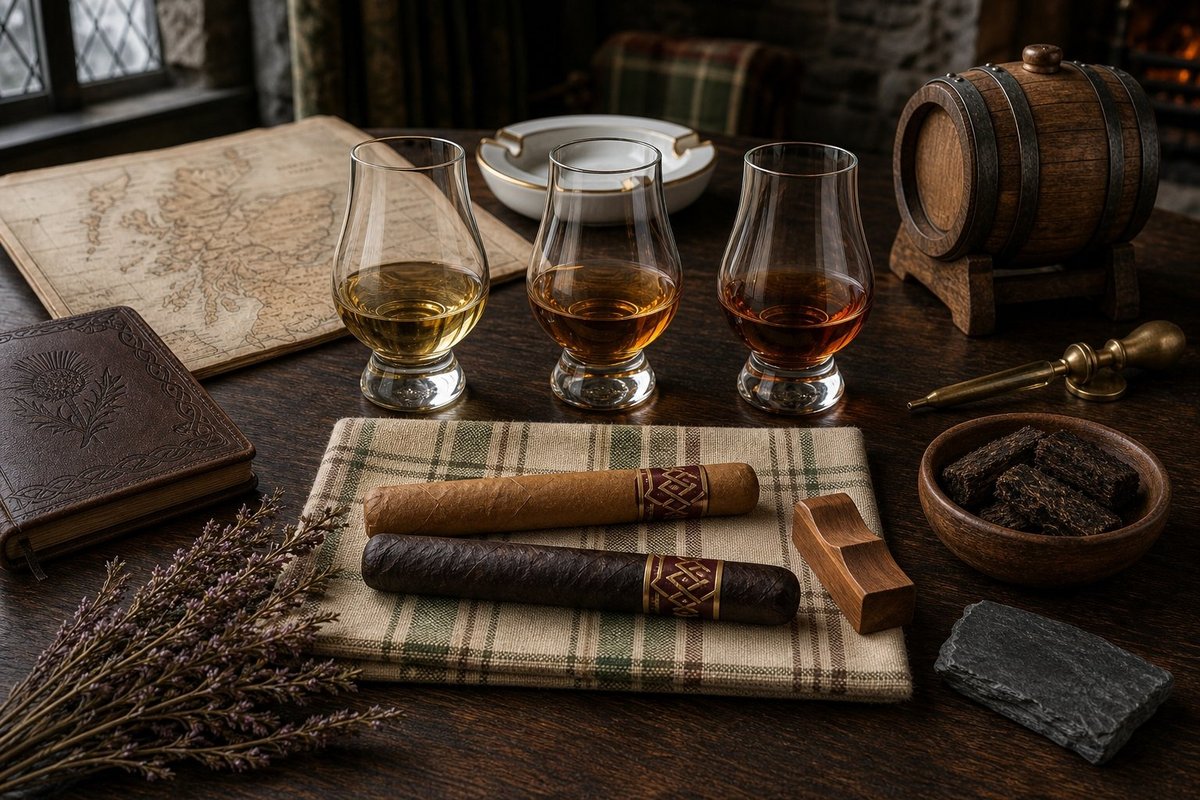
Scotland's distilling regions — Highland, Speyside, Lowland, Campbeltown, and Islay — each produce a distinct style of single malt whisky, and each style pairs with a distinct category of premium cigar. The serious cigar traveler's whisky journey through Scotland is, properly conducted, a structured pairing tour rather than a pub crawl.
Speyside — The Sherried Style
The Speyside region, in the northeastern Highlands along the River Spey, produces the most internationally distributed style of Scottish single malt. The signature Speyside character — sherry cask aging, dried fruit, honey, gentle oak — pairs with medium-bodied Dominican premium cigars in a way that the international cigar-and-whisky tradition has been refining for decades.
The essential Speyside pairings: Glenfiddich 18 with a Davidoff Aniversario No. 3 (the dried-fruit notes of the whisky echoing the wrapper's character); The Macallan 18 Sherry Oak with an Arturo Fuente Don Carlos Robusto (the deep sherry character matching the cigar's restrained Dominican profile); Aberlour A'Bunadh with a Padrón 1964 Anniversary Maduro (the cask-strength richness handling the Nicaraguan power without being overwhelmed).
Highland — The Versatile Style
The broader Highland region, encompassing the northern and central Highlands beyond Speyside, produces a more varied portfolio of single malts. Highland malts range from the lighter, floral character of the central Highlands to the maritime intensity of the northern Highlands; the pairing strategy depends on the specific distillery.
The most reliable Highland pairings: Glenmorangie 18 (a softer, floral malt) with a Fuente OpusX Robusto (the cigar's complexity matching the whisky's restraint); Highland Park 18 (a more maritime malt with subtle peat) with a Cohiba Siglo VI (the Cuban tradition handling the gentle peat character with sophistication); Dalmore 18 with a Hoyo de Monterrey Epicure No. 2 (the whisky's chocolate notes matching the Cuban's classical balance).
Islay — The Peated Style
The island of Islay, off the western coast, produces the world's most distinctive peated single malts. The Islay character — heavily peated, with substantial maritime salt influence — is, for cigar pairing purposes, the most challenging category in Scotch whisky.
The Islay pairing principle: the peated whisky requires a cigar capable of holding its own against the substantial smoke and salt character. The reliable pairings: Lagavulin 16 with a Padrón 1926 Series Maduro (the cigar's deep maduro sweetness balancing the whisky's heavy peat); Ardbeg 10 with a Liga Privada No. 9 (the cigar's Broadleaf wrapper and the whisky's young aggressive peat working together as a deliberate intensity exercise); Bowmore 18 (a more restrained Islay) with a Davidoff Royal Release Robusto (the more refined pairing for the visitor who wants Islay character without the dominant peat).
The Islay pairing is not for the contemplative evening; it is for the assertive evening, when the smoker wants both the cigar and the whisky to make substantial claims. The pairing is correctly conducted with one cigar per whisky bottle, not multiple cigars in sequence; the palate fatigue from repeated Islay pairings is substantial.
Campbeltown and Lowland — The Specialty Cases
The Campbeltown region (now reduced to three operating distilleries) produces a distinctive maritime style that pairs with medium-bodied Cuban cigars in interesting ways. Springbank 18 with a Trinidad Fundadores is the canonical Campbeltown pairing.
The Lowland region produces lighter, less assertive single malts that are typically not the principal Scotch category for cigar pairing. The Lowland malts are best appreciated independently; cigars compete with the whisky's character rather than complementing it.
The Trip Itself
The Scotland whisky journey for the cigar traveler is best structured as a one-week tour anchored on three or four days in Speyside (with day trips to specific distilleries), two days in Islay (with at least one distillery tour and one or two evenings at the Port Ellen or Port Charlotte cigar-and-whisky establishments), and one or two days for the journey's central and Highland components. The accommodation strategy should be country-house hotels (Inverlochy Castle, Cromlix House, the Atholl Arms) rather than pure tourist hotels; the cigar-and-whisky service at the country-house tier is substantially better than at the tourist properties.
The journey's principal lesson is that Scotch whisky and premium cigars share a common discipline: both reward slow attention, both deliver their full character only at proper temperature and proper pacing, both are improved by the social context of shared appreciation rather than solitary consumption. The whisky journey is an extended seminar in that discipline; the cigar traveler who treats it as such returns home with a refined palate and a substantial set of pairing references.