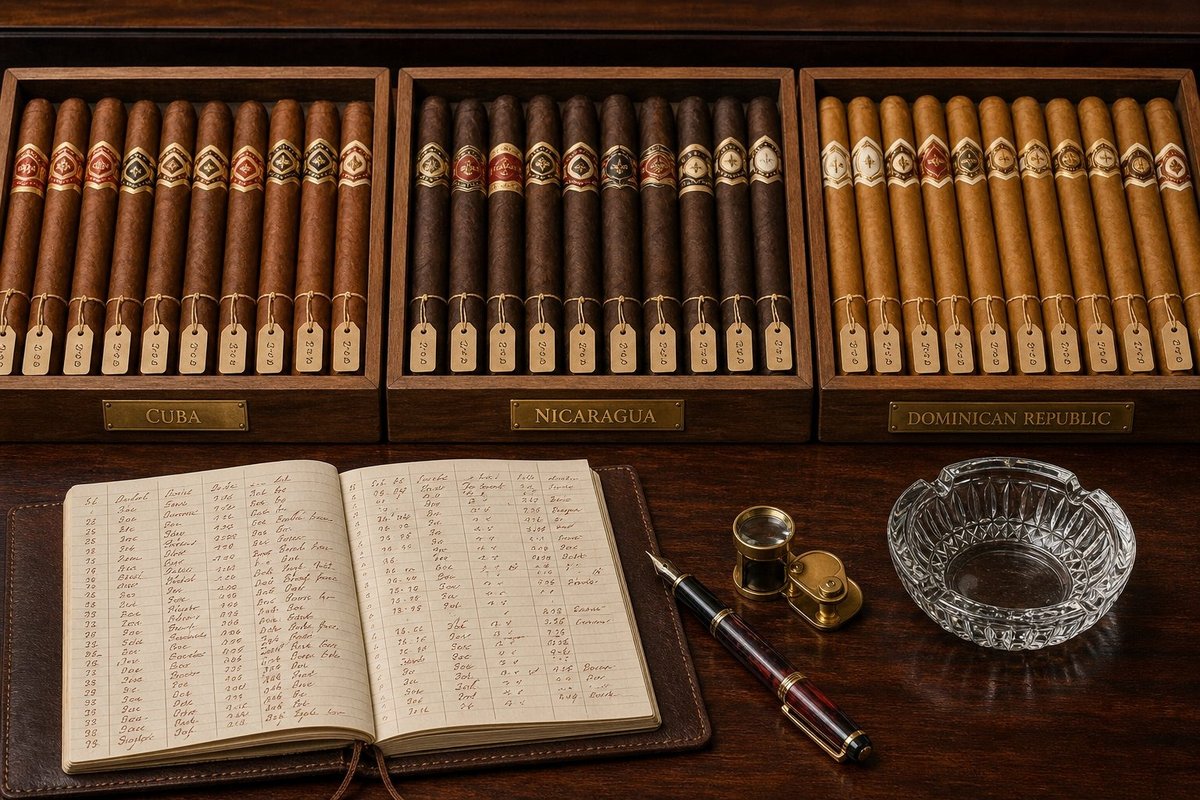
The global premium cigar market in 2026 has been reshaped by three forces: the Nicaraguan ascendancy, the Cuban pricing crisis, and the rise of boutique brands that operate outside the traditional factory consolidation. The result is a more competitive, more fragmented, and ultimately more interesting market than the one that existed a decade ago.
Volume by Country
Global premium cigar production in 2025 totaled approximately 540 million sticks, allocated roughly as follows:
- Nicaragua: 195M sticks (36% of global premium volume) — the largest single producing country, anchored on Estelí, Jalapa, and Condega valleys
- Dominican Republic: 165M sticks (31%) — the historical post-revolution leader, with the Cibao Valley as the principal producing region
- Honduras: 75M sticks (14%) — the Jamastrán and Copán regions, with substantial Olancho production
- Cuba: 95M sticks (18%) — flagship Habanos S.A. lines, channeled through the Habanos international distribution network
- Other (Mexico, USA, Brazil, Ecuador, etc.): approximately 10M sticks combined
The Nicaraguan dominance is structural: the country has more available agricultural land at suitable elevation, lower labor costs than the Dominican Republic, and a tobacco-production infrastructure that has consolidated dramatically since 2010. The Estelí factories — Padrón, My Father, AJ Fernandez, Joya de Nicaragua, Aganorsa, Plasencia, Drew Estate — produce the bulk of the contemporary mid-to-upper premium tier.
Pricing Trends
Premium cigar pricing in 2026 reflects four distinct dynamics. First, the Cuban pricing crisis — Habanos S.A. has repositioned Cuban product at the very top of global pricing across the 2018–2024 period, with flagship lines (Cohiba Behike, Edición Limitada releases) now retailing at $40–80 per cigar. Second, the premium consolidation — the mid-priced segment ($8–15 per cigar) is contracting as smokers either trade up to the $15–30 tier or down to value-driven brands. Third, the boutique premium emergence — independent brands like Crowned Heads, Warped, Foundation, Aganorsa, and the smaller-scale Padrón Family Reserve and Fuente OpusX lines occupy a new $20–40 tier that competes with Cuban flagships on quality. Fourth, the limited-edition inflation — annual editions, anniversary cigars, and prestige releases routinely retail at $50–150 per cigar and routinely sell out at those prices.
The Boutique Disruption
The most interesting development of the 2020s has been the emergence of boutique premium brands operating outside the traditional factory consolidation. These brands — typically founded by industry veterans with deep factory relationships — produce limited annual volumes (often under 500,000 sticks annually), maintain direct creative control over blending decisions, and command premium pricing because the production is genuinely scarce.
Examples include Crowned Heads (Tennessee-based, factory production in Estelí), Warped (Cuban-style production from Miami), Foundation (Aganorsa-affiliated, focus on Charuto and El Güegüense lines), and the brand-house tier of Plasencia (which produces under multiple boutique labels in addition to its own line). The boutique brands have captured significant share in the connoisseur segment — readers who pay close attention to industry developments and prioritize blending creativity over established brand pedigree.
The traditional houses have responded with their own limited-release programs, and the line between "boutique" and "house" has blurred. What remains distinct is the scale: a Padrón Family Reserve or Fuente OpusX is still produced at thousands of boxes annually; a Crowned Heads release is often produced at hundreds of boxes annually. The scarcity is the value proposition.
Regional Shifts
The Dominican Republic, after dominating premium production from 1962 to 2005, has settled into a stable but no longer dominant position. The Cibao Valley factories — Davidoff's Tabadom, Fuente's flagship operations, La Aurora — continue to produce flagship Dominican lines, but the cutting-edge blending and the boutique innovation have largely moved to Nicaragua. Dominican production remains essential for the Connecticut-shade premium tier (Davidoff Aniversario, Fuente Hemingway, Macanudo) and for the upper traditional segment.
Honduras has stabilized as a Corojo-tradition producer with steady production volume and improving quality. The Camacho relaunch, the Punch Honduran line, and the Rocky Patel Honduras-sourced blends represent the modern Honduran segment. Mexican San Andrés production has expanded significantly as a wrapper-leaf supplier; the Mexican domestic premium industry remains small but growing.
The emerging premium origins — Ecuador (wrapper-leaf specialization), Cameroon (a recovering wrapper tradition), Brazil (Mata Fina and Arapiraca leaf), Indonesia (Sumatran-tradition production), the Philippines (the Tabacalera de Filipinas operations) — contribute specific leaf types to global premium blends without yet competing for flagship-cigar identity in their own names.
The Outlook
The next five years will likely see continued Nicaraguan dominance in production volume, continued Cuban dominance in prestige pricing (despite the quality controversies), and continued boutique-segment expansion as consumer attention concentrates on independent brands with distinctive blending identities. The total global premium volume is likely to remain in the 500–600M annual range; growth in this category has been roughly flat since 2018, reflecting consumer demographic shifts that are slightly offsetting the per-capita increases in serious-aficionado consumption.
The question that animates this magazine — whether the next great cigar will come from Cuba, from Nicaragua, or from a producer not yet on the map — is, as of 2026, genuinely open. We will continue to taste and we will continue to score. The market will sort itself out. The leaf, in the end, is the only thing that matters.
From Cigar & Cocktail Magazine Q1 2026.