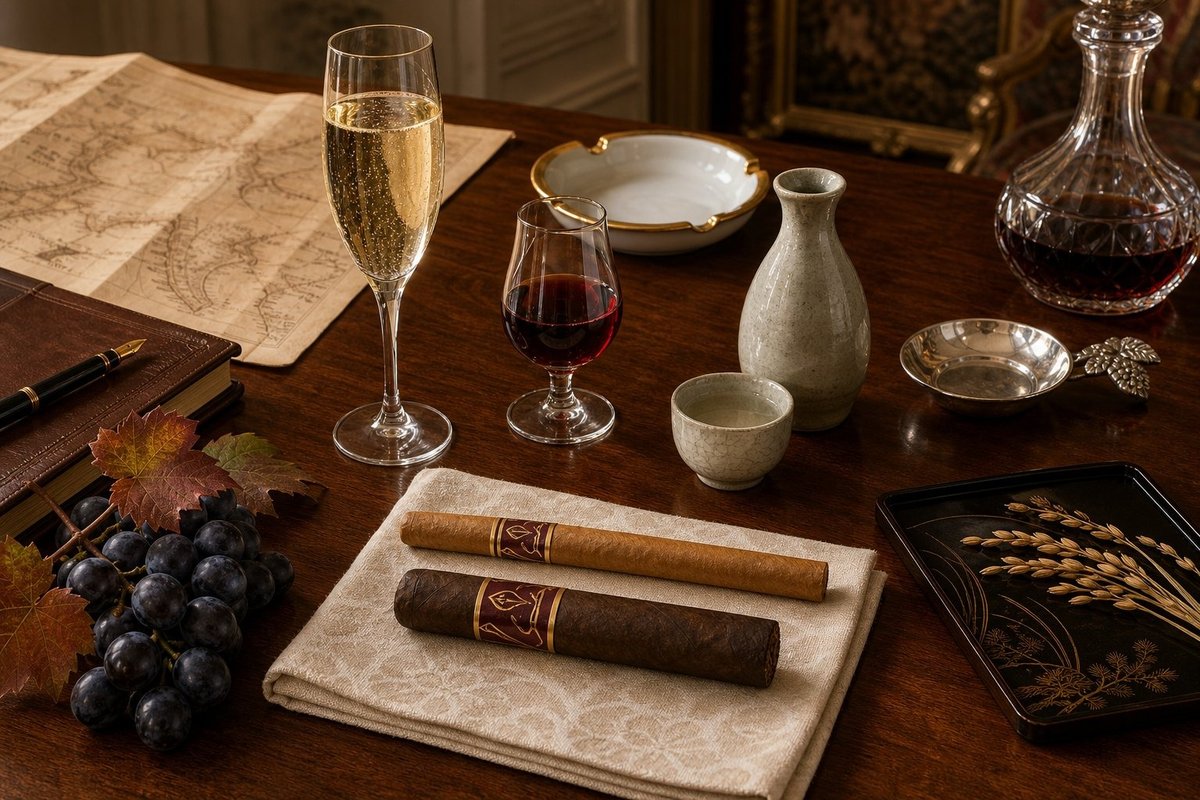
The Negroni is the most adaptable spirit-forward cocktail in the modern bar. Equal parts gin, Campari, and sweet vermouth — three ingredients, one ratio, infinite variations. The architecture survives any spirit substitution: replace the gin with bourbon and you have a Boulevardier; with rye and dry vermouth you have an Old Pal; with rum you have a Kingston Negroni; with mezcal you have a Mezcal Negroni. Each variation rebalances the cocktail's center of gravity and changes which cigar it wants to be drunk with.
The Classic Negroni
Build: 30ml London Dry gin, 30ml Campari, 30ml sweet vermouth. Stir with ice. Strain over fresh ice in a rocks glass. Express and discard an orange peel.
The classic Negroni was invented in Florence around 1919, when Count Camillo Negroni asked his bartender at Caffè Casoni to fortify an Americano (Campari + sweet vermouth + soda) by replacing the soda with gin. The cocktail's bitter-sweet-herbal triangulation has survived a century essentially unchanged. The juniper-forward gin (Tanqueray, Beefeater, Bombay Sapphire) anchors the bitter Campari and the herbal sweet vermouth in a triangular balance where no single ingredient dominates.
Cigar pairing: Medium-bodied Dominican cigars — Davidoff Aniversario, Fuente Hemingway, Macanudo Vintage. The Negroni's bitter complexity creates a productive contrast with the cigars' refined Connecticut-shade profiles. Less suited to full Nicaraguan smokes where the bitterness overwhelms.
The Boulevardier
Build: 45ml bourbon, 30ml Campari, 30ml sweet vermouth. Stir with ice. Strain over fresh ice in a rocks glass or up in a coupe. Garnish with orange peel.
The Boulevardier replaces gin with bourbon. The bourbon's caramel-and-vanilla base depth allows the bitter Campari to register more as an aromatic complement than a structural bitter; the cocktail becomes warmer, rounder, more autumn-forward. The bourbon's additional sweetness justifies a slight upweighting of the spirit measure to 45ml (versus the classic 30ml).
Cigar pairing: Nicaraguan full-strength production — Padrón 1964 Anniversary, My Father Le Bijou, Aganorsa Leaf Signature. The Boulevardier's warm bourbon base finds common ground with Estelí terroir's dark fruit and leather notes. The most versatile of the Negroni variations for cigar work.
The Old Pal
Build: 30ml rye whiskey, 30ml Campari, 30ml dry vermouth. Stir with ice. Strain into a chilled coupe. Garnish with lemon peel.
The Old Pal replaces both gin (with rye) and sweet vermouth (with dry vermouth). The cocktail is dramatically drier and more spirit-forward than the classic Negroni — almost an aperitif Manhattan. The dry vermouth's restraint allows the rye's spice character to dominate the spirit dimension while the Campari provides the bitter spine.
Cigar pairing: Dry, drier, drier still. The Old Pal pairs particularly well with Dominican Connecticut-shade production where the dry character mirrors the cigar's restraint. Less suited to maduro wrappers, where the cocktail's lack of sweetness becomes a deficit rather than a feature.
The Kingston Negroni
Build: 30ml Smith & Cross Jamaican rum (or equivalent funk-forward white rum), 30ml Campari, 30ml sweet vermouth. Stir with ice. Strain over fresh ice in a rocks glass. Garnish with orange peel.
The Kingston Negroni replaces gin with high-ester Jamaican rum. The substitution is more drastic than the Boulevardier's bourbon substitution; the rum's funk-forward esters create an entirely different aromatic landscape. Smith & Cross at full strength (57% ABV) is the canonical base; Hampden Estate Rum Fire works equally well. Aged Jamaican rum is not the right substitute — the cocktail wants the unaged ester intensity.
Cigar pairing: Full Nicaraguan and Honduran cigars with substantial complexity. The rum's funk character finds common ground with the dark-fruit and leather notes of Estelí terroir; the Campari provides the bitter spine that prevents the rum-tobacco combination from becoming overwhelming. A Padrón 1926 No. 1 with a Kingston Negroni is the late-summer-Caribbean expression of the cigar hour.
The Mezcal Negroni
Build: 30ml mezcal (Del Maguey Vida or equivalent), 30ml Campari, 30ml sweet vermouth. Stir with ice. Strain over fresh ice in a rocks glass. Garnish with orange peel.
The Mezcal Negroni is the contemporary variation. The mezcal's smoky character adds a fourth dimension to the cocktail's flavor profile — bitter, sweet, herbal, smoky. The cocktail is divisive; aficionados either find the smoke-on-smoke effect intoxicating or find it overwhelming. The mezcal substitution rewards the patient — the cocktail opens up over the first ten minutes as the smoke notes integrate with the Campari and vermouth.
Cigar pairing: Difficult. The mezcal's smoke already provides what the cigar contributes, creating a redundancy rather than a complement. Best paired with Mexican San Andrés-wrapper cigars (matching origin), or with very light Connecticut-shade smokes where the cigar's mildness creates contrast rather than redundancy. Approach with caution; this is not a universal pairing.
The Architecture Survives
What makes the Negroni family interesting is that the equal-parts architecture survives every spirit substitution. The 1:1:1 ratio works because Campari and sweet vermouth have specific aromatic and bitter profiles that handle any spirit base in approximately equal proportion. A different cocktail family — the Manhattan, for example — does not adapt this way; substituting brandy for the whiskey produces a different cocktail with a different name (the Brandy Manhattan), not a variation that maintains the original identity.
The serious cigar smoker can build an entire evening on Negroni variations alone. Start with a classic Negroni before dinner. Move to a Boulevardier with the first cigar. Switch to an Old Pal as the evening progresses. Close with a Mezcal Negroni or Kingston Negroni depending on the season and the company. The architecture endures.
Full Negroni and Boulevardier guides are in the Cocktails section. From Cigar & Cocktail Magazine Q1 2026.