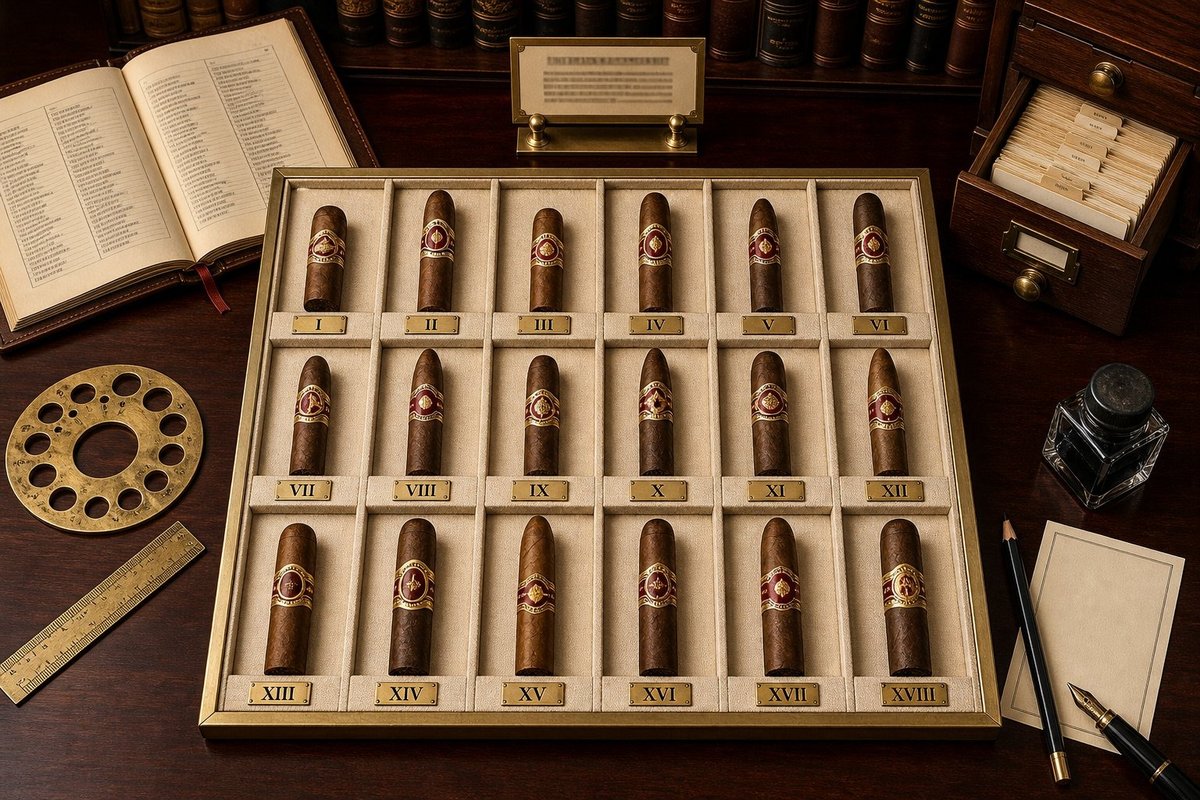
A serious cigar collection, properly assembled and maintained, can appreciate at rates that rival the secondary market for premium spirits or fine wine. The investment-grade humidor is a particular discipline: not every premium cigar appreciates, the appreciation is non-linear, and the discipline required to realize the appreciation is substantially more demanding than passive ownership.
What Appreciates
Three categories of premium cigar reliably appreciate on the secondary market. The first is pre-embargo Cuban cigars (production dated before 1962, principally vintage Davidoff and the discontinued Cuban marcas). The pre-embargo market is the most prestigious category in cigar collecting; properly authenticated examples regularly trade at multiples of 20–50x their original retail price. The market is small, specialist, and requires substantial expertise to navigate safely (counterfeit risk is substantial).
The second category is limited Edición Limitada and Reserva releases from Habanos S.A.: the annual EL and RR releases of the major Cuban marcas, particularly when stored for five-plus years post-release. The EL releases appreciate at rates of approximately 5–8% per year compounded for the first decade after release, with substantial upside for releases that develop strong critical reception. The 2010-2015 ELs from Cohiba, Trinidad, and Partagás have, in 2026, appreciated 2–3x their original retail prices.
The third category is discontinued or rare lines from major boutique houses: production runs that are explicitly limited (the Padrón Family Reserve numbered series, the Fuente OpusX BBMF series, the My Father Special Edition releases) appreciate substantially when production ends. The Padrón Family Reserve 50th Anniversary, originally released at $40 per cigar, currently trades on the secondary market at $200–400 per cigar depending on box condition.
What Does Not Appreciate
The collector who hopes to invest in cigars should be clear about what does not appreciate. Standard production lines (the regular-release Cohiba, Padrón, Davidoff, and similar) typically maintain their retail value but do not substantially exceed it on the secondary market. Cigars produced in large volume do not develop the scarcity premium that drives appreciation in the limited categories.
Counterfeits, of which there are many, do not appreciate. The substantial trade in counterfeit Habanos that supplies the lower-end secondary market is one of the principal risks to the collector who is not experienced in authentication. A "vintage" Cohiba acquired through an unverified channel is, with substantial probability, a counterfeit; the verification process requires specific expertise and is best conducted through established authentication services.
The Operational Discipline
The investment-grade humidor differs operationally from the consumption humidor in three respects. The first is scale: the investment collection typically runs to 500–2,000 cigars, requiring a cabinet or walk-in rather than a desktop humidor. The cabinet humidor is the operational standard for serious investment collecting; the climate control on the cabinet humidor is electronic rather than passive, and the temperature stability is substantially better than the desktop humidor can maintain.
The second is documentation: every box and every cigar in the investment collection must be documented with acquisition date, source, original price, box code, and any relevant authentication. The documentation enables eventual sale (the secondary market requires provenance) and supports insurance coverage (which is essential for collections above approximately $25,000 total value).
The third is rotation discipline: the investment collection is not for smoking. Smoking the cigars defeats the investment thesis. The investment collector maintains a separate consumption humidor for daily smoking and reserves the investment humidor for the long-term hold strategy. The cross-contamination of investment cigars into consumption is the most common cause of investment collection underperformance.
The Time Horizon
The appropriate time horizon for cigar investment is seven to fifteen years from acquisition. Shorter holds typically do not realize the appreciation potential; longer holds risk the deterioration that all biological products eventually experience. The standard investment strategy is to acquire at retail or close to it, store for ten years, and sell into the secondary market at the point of appreciation peak.
The collector should be clear that cigar investment is illiquid: the secondary market is not deep, and rapid liquidation will sacrifice substantial appreciation. The investment is appropriate for the collector who can hold the position for the full time horizon and who values the cigars as a multi-decade store of value rather than as a near-term trading position.
The Verdict
The investment-grade humidor is a viable alternative store of value for the collector who has the expertise and the storage capacity to manage it. The discipline required is substantial; the appreciation potential is real but requires patience and the willingness to forgo consumption of the investment-tier cigars. For the collector who is principally a smoker rather than an investor, the consumption humidor is the appropriate scale; for the collector with the resources and the discipline to maintain a separate investment collection, the appreciation potential makes the investment humidor an attractive long-term position.