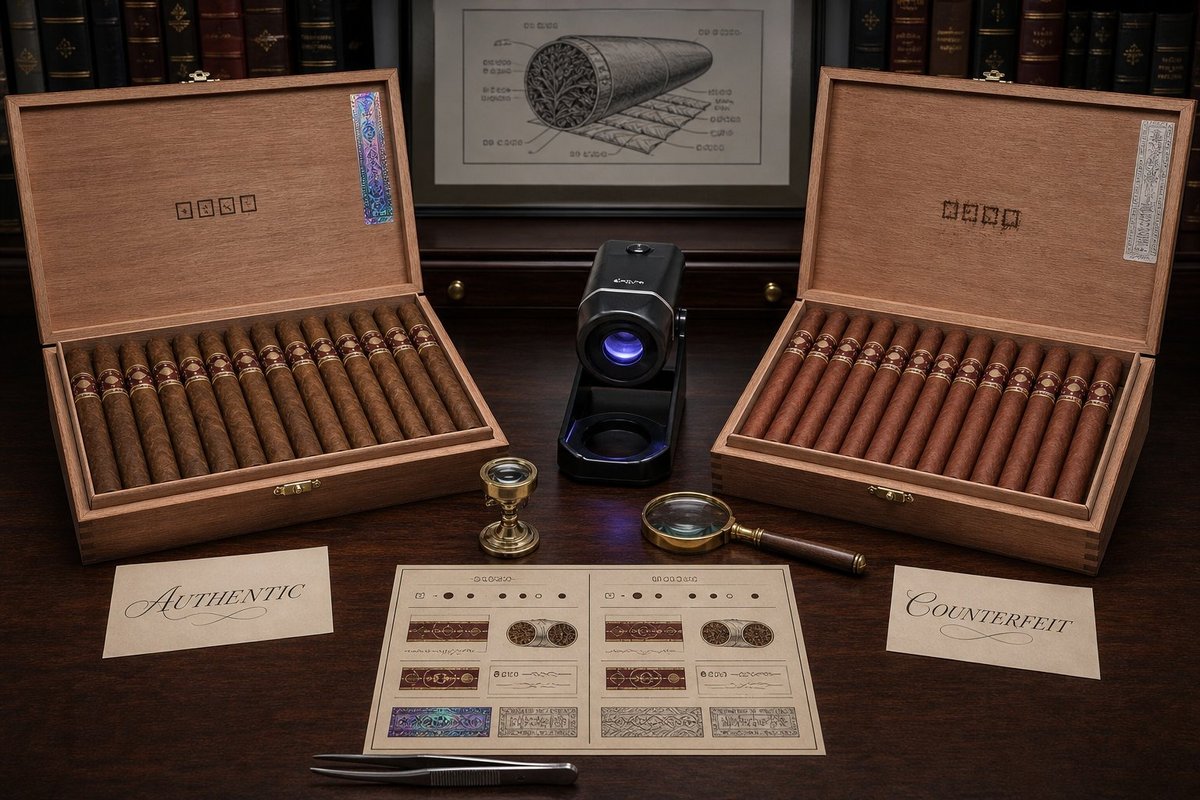
The counterfeit Habanos market is larger than the legitimate one. Estimates from Habanos S.A. itself put the global counterfeit volume at five to seven times legitimate Cuban production — meaning that more than eighty percent of the cigars sold as Cuban worldwide are fakes. Most are made in the Dominican Republic and Honduras, filled with mixed Caribbean tobacco, banded with photocopied paper, and sold to tourists who never know the difference.
The Band Is Not Proof
Counterfeit bands have become extraordinarily good. The cheap fakes — pixelated printing, wrong fonts, missing gold leaf — still exist, but they are no longer the principal threat. The serious counterfeit operation now produces bands that are visually indistinguishable from genuine Habanos bands under casual inspection. The gold ink is real gold leaf. The embossing is correct. The colors match the Pantone references the legitimate factories use.
What the counterfeiter cannot easily fake is the band's application. The genuine Habanos band is applied at the factory by hand, with a specific vegetable gum, at a specific angle relative to the head of the cigar, with the band's seam positioned at the back. The counterfeit operation, working in larger volumes with less skilled labor, often gets the angle wrong, the seam in the wrong place, or the gum reservoir on the wrong side of the band. These are the details a connoisseur looks for first.
The Construction Tests
The first construction test is weight and density. Pick up the cigar and roll it between thumb and forefinger. A genuine Cuban robusto weighs approximately 12 to 14 grams and feels dense, with consistent firmness from foot to head. A counterfeit cigar — typically filled with shorter, less expensive filler tobacco — feels lighter, sometimes hollow at the foot, sometimes with detectable lumps where the buncher rushed the filler arrangement.
The second test is the cap inspection. The genuine Cuban triple-cap construction shows three visible cap layers when examined closely at the head. Most counterfeit cigars use a single or double cap; the deception is visually subtle but detectable with a 10x loupe. The cap leaf should match the wrapper in color, texture, and aging — counterfeit cap leaf is often a slightly different shade because it was sourced separately from the wrapper.
The third test is the cold draw. After cutting, draw on the unlit cigar. A genuine premium Cuban produces a draw that is firm but free, with detectable cedar, sweet hay, and a faint fermentation note. A counterfeit produces either a draw so tight it nearly suffocates (over-bunched) or so loose that the cigar feels empty (under-filled), and the cold draw flavor is typically flat or vegetal — the absence of long Cuban fermentation announces itself before the cigar is lit.
The Box Inspection
If the cigars are presented in a box, the box itself carries multiple authenticity signals. The genuine Habanos box has:
- A holographic seal applied across the lid, introduced in 2010 and revised periodically. The hologram shifts color when tilted. Counterfeit holograms are typically static.
- A barcode that scans against the Habanos online verification database. The barcode label is on the lower right of the box bottom.
- A factory code stamped on the box bottom in green ink — three letters identifying the producing factory (FPG = El Laguito / Cohiba, BM = Briones Montoto / Romeo y Julieta, etc.).
- A box code in black ink showing the production date and a separate four-letter rolling code identifying the rolling team and rolling date.
The Habanos verification site (habanos.com) accepts the barcode and returns confirmation of legitimacy for boxes manufactured 2010 or later. This is the single most reliable authentication method available to consumers. Use it.
The Economics
This is the part the romantics do not want to discuss. The counterfeit Habanos market exists because there is a massive willingness-to-pay gap between what tourists want to spend and what genuine Habanos cost at duty-free or LCDH retail. A tourist in Cancún sees Cuban cigars at $40 a box on the beach. The genuine product retails at $300+ in Geneva. The gap is irresistible. Both seller and buyer participate willingly. Most of the buyers go home convinced they got a deal.
The serious aficionado has three options. One: buy only at La Casa del Habano locations and verified specialty retailers in countries where Habanos S.A. has direct distribution (Spain, UK, Switzerland, Germany, Hong Kong, Singapore, Cuba itself). Two: buy from established secondary-market specialists (5th Avenue Cigars, Cigarworld, the major UK auction houses) who guarantee provenance and absorb the reputational cost of selling fakes. Three: smoke Nicaraguan and Dominican premium cigars exclusively, accept that the counterfeit market is not a problem you can navigate around, and forgo the Cuban experience entirely. All three are defensible positions.
What is not defensible is buying $40 boxes on a beach and claiming they are real.
The full Cuban brand profiles, with factory codes and authentication notes, are in the Brands & Producers section. From Cigar & Cocktail Magazine Q1 2026.