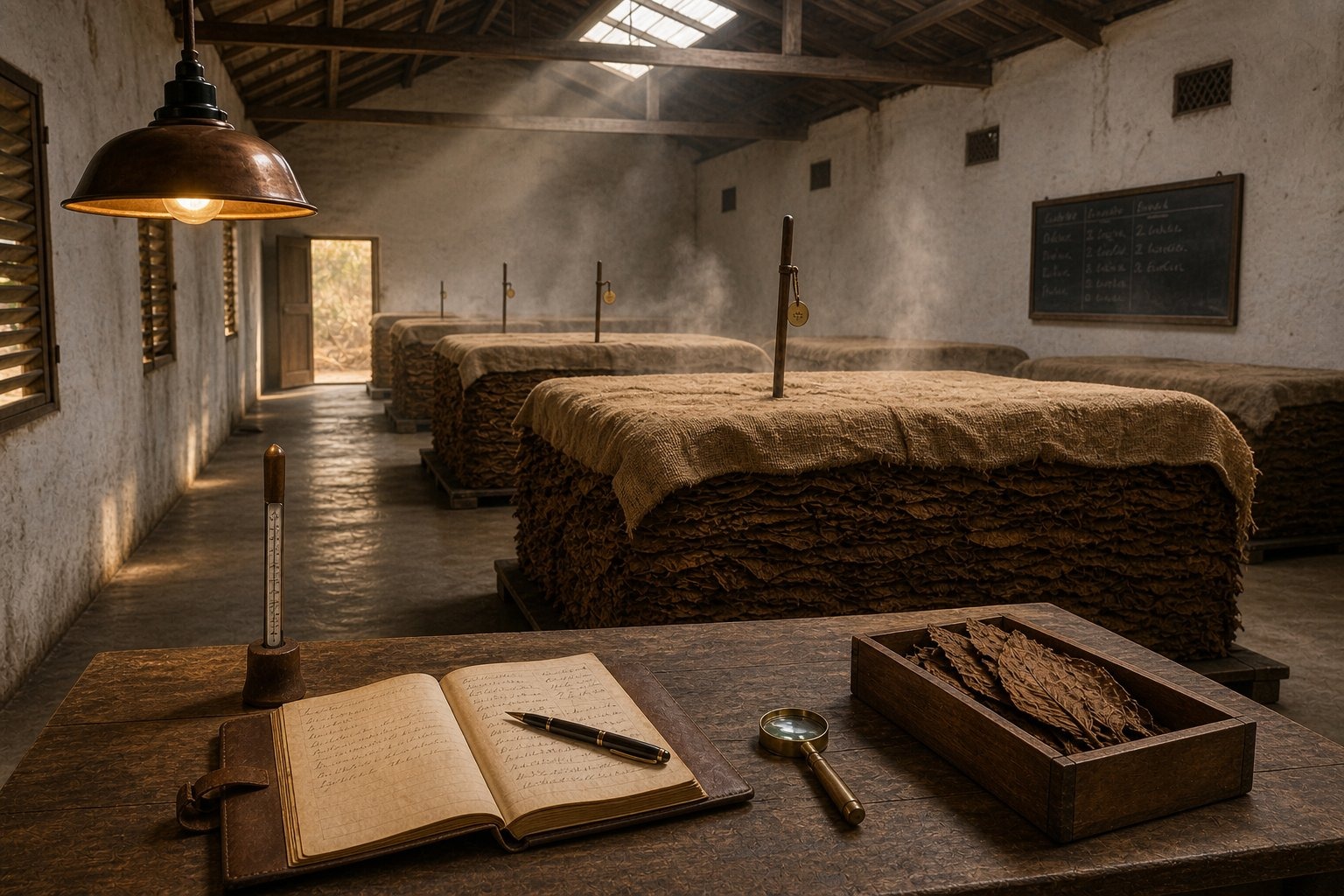
Forty-six degrees Celsius. He nods once, makes a note in his leather book, and moves to the next pilón. There are six of them in the room, each approximately three meters long and two meters wide and a meter and a half tall, each weighing somewhere between one and three tons, each covered in coarse burlap and bound with hemp rope. They have been here, in their current configuration, for nine days.
This is the first fermentation pass for this batch — the longest and most consequential of the two or three passes the tobacco will undergo before it is considered ready for aging. The work, such as it is, is being done by microorganisms native to the cured leaf, activated by the residual moisture under the weight of the pile, generating heat as a byproduct of metabolizing the leaf's nitrogenous compounds and natural sugars.
Forty-six degrees Celsius is the upper end of the master's target range. He will, I think, order the first pilón turned tomorrow morning — unstacked, the cooler outside leaves moved to the interior, the hotter interior leaves moved to the exterior, the temperature curve reset for the second week of the cycle. He has not told me this yet. He will tell the workers tomorrow, when it matters.
The thing I keep coming back to, in fermentation rooms like this one, is how chemical the work is. Not in the sense of synthetic chemistry — nothing here is added, nothing here is engineered — but in the sense that the cigar's character, its eventual flavor profile, its smokability itself, is being determined right now by molecular processes I cannot see and the master cannot fully describe. He has spent forty years learning what to do; he has not, in any explicit sense, spent forty years learning why what he does works. The microbiology of cigar fermentation is a research field still in its early decades. The traditional practice is two centuries older.
The master pulls a single leaf from the open edge of the second pilón, holds it up to the light from a window, and hands it to me without speaking. The leaf is dark brown, slightly damp, faintly aromatic with the warm cured-tobacco smell that anyone who has stood near a humidor for any length of time will recognize, but layered over it is a sharper note — the ammonia. The leaf is mid-fermentation. It is not yet smokable. In another nine months, after the second pass and the start of aging, it will be on its way to becoming the filler of someone's Robusto in 2028.
I have been thinking, on this trip, about how the cigar industry talks about itself. Most of the marketing copy I read — from every producer, in every country — focuses on the cigar at the point of consumption. The flavor notes, the pairing suggestions, the lifestyle imagery, the "moments." Almost none of it focuses on the work being done in this fermentation house at this moment, by this man, with these pilones. And yet this room is, in my honest opinion, where premium cigars are actually made. The rolling, the wrapping, the boxing, the banding — these are the finishing steps. The character of the cigar was determined here, in March, by the master who is now writing 46 in his book.
If you smoke a cigar that surprises you with its quality, the surprise was made in a room like this one. If you smoke a cigar that disappoints you with harshness or unintegrated flavor, the failure was probably here too. The master's hands and the master's notebook are, more often than not, the difference.
I leave the fermentation house at about four in the afternoon. The master nods at me as I go, makes another note — not about the pilones, this time, but about something on the next page. I do not know what it says. I do not need to. The man has been doing this since before I started smoking cigars, and his work continues regardless of whether I or any other writer ever describes it.
Estelí is one of three towns in the world — the others are in the Vuelta Abajo and in the Cibao Valley — where the slow chemistry of becoming smokable is happening today, in fermentation rooms exactly like this one, in the way it has happened for the better part of two hundred years. It is a quiet place. It deserves more attention from the writers of cigar prose than it generally receives.
— Radim Kaufmann, Estelí, March 2026